Spring Cat Shedding: What's Normal and What to Do About It
Spring is the heaviest molt of the year for most cats, 4 to 6 weeks of dropped winter undercoat between March and May. Here's why it happens and what actually helps.

Spring is the heaviest molt of the year for most cats, and it's not because it got warm. The trigger is daylight, not temperature, and your cat's coat starts dumping winter undercoat the second week of March whether your spring is mild or cold. In my house that's 4 to 6 weeks of dramatic shedding from Leo and Luna, my 2 backyard rescues, and a milder bump from Herbie, my indoor-from-kittenhood longhair.
This is part of the main cat hair guide, broken out because the spring molt is its own problem. Brushing twice a week stops being enough, the vacuum runs more often, and longhairs that were fine in February are growing mats behind a back leg by April. The fix is mechanical, not magical. Brush more, vacuum more, watch the skin. That's the whole protocol.
The biology
Why spring is the heaviest molt
Cats grow a thicker undercoat through fall and winter and release it in spring as the days get longer. The signal is photoperiod, the amount of daylight the cat is exposed to. The pineal gland reads the lengthening days, melatonin levels shift, and the coat starts transitioning from winter mode to summer mode. Temperature is a secondary cue at most. A cold spring with long days will still kick off the molt right on time.
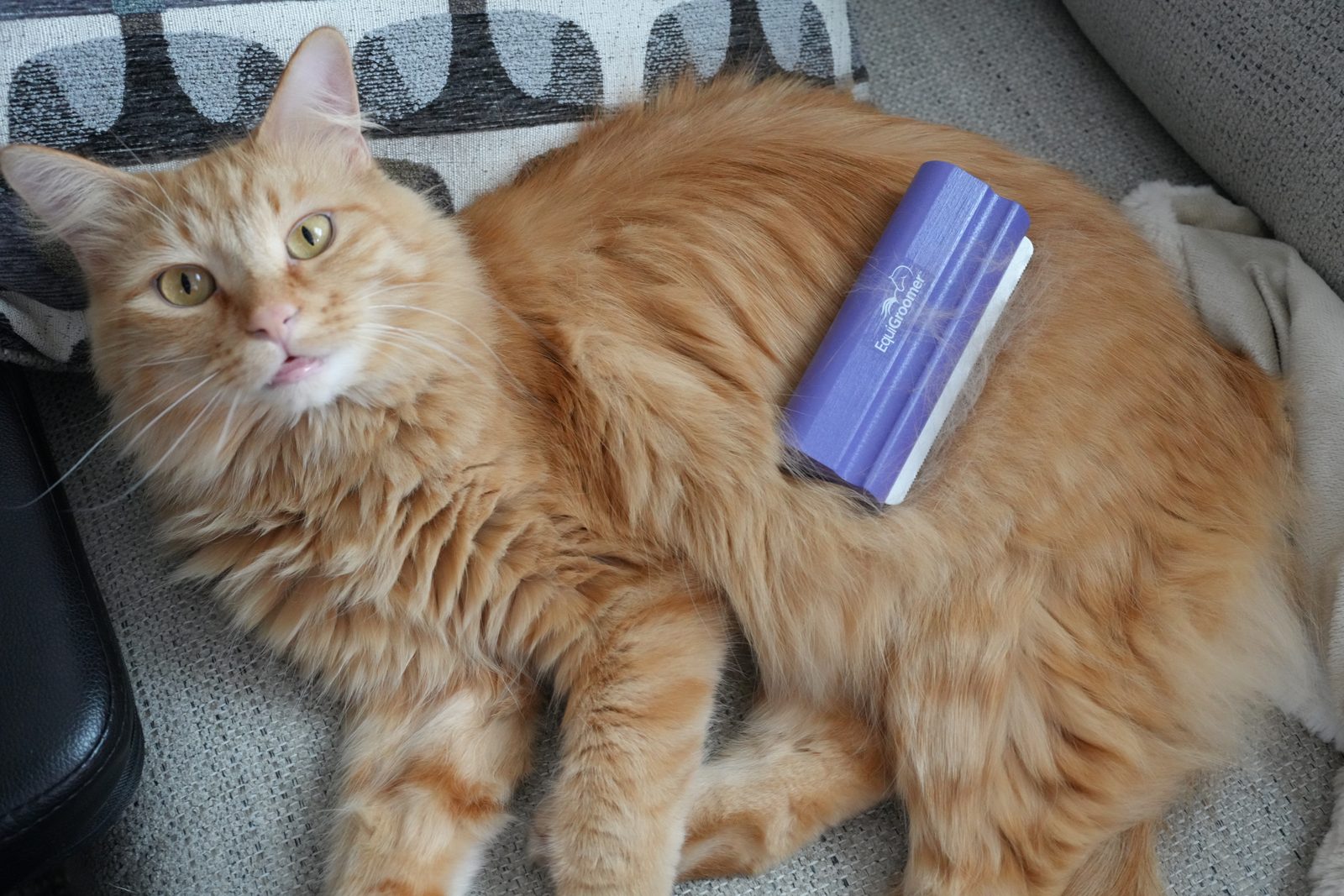
The reason spring molt is bigger than fall molt is straightforward. The winter undercoat is denser and longer than the summer one, so when the winter coat releases there's just more of it to come out. Fall sheds back to a slightly thicker coat, spring sheds back to a much thinner one. That's why the pile of fur on the EquiGroomer in April is twice the pile in October.
The cycle is the same on every cat with a double coat, indoors or out. What changes is the size of the winter coat the cat grew in the first place, and that depends on how much cold and how much daylight variation the cat actually saw. A cat that lived outside through January grew a heavier winter coat than a cat that spent it on a couch in a 70 degree apartment. Come March, both molt, but the one with the bigger winter coat sheds way more.
By lifestyle
Indoor vs outdoor cats in spring
This is where my 3 cats line up neatly into a controlled experiment. Herbie is indoor from kittenhood, Leo and Luna are siblings I raised from kittens in the backyard before bringing them in. Same house, same climate, same food, same brushing schedule. The spring molt looks completely different on each of them.
Leo sheds more evenly across the year. He has a bump in March and another in September, both noticeable, neither dramatic. The vacuum picks up more hair off the rugs in spring than in winter, but I'm not finding clumps on the couch. He grew up in a temperature-controlled apartment with consistent indoor lighting, his coat never had to do dramatic seasonal work, and the molt reflects that.
Herbie and Luna are a different story. Both came from outside, both still have the heavy double coat their first few winters trained into them, and both blow coat in March like they're trying to leave a second cat on the floor. Luna in particular is shy and won't sit for long brushing sessions, so the loose undercoat ends up on every chair she touches for about 4 weeks. Indoor-only cats with windows and natural light still get the photoperiod signal, the molt just runs smaller because the winter coat was smaller to begin with.
The timeline
How long it lasts
4 to 6 weeks of peak molt for most cats, somewhere inside the March to May window in the Northern Hemisphere. The first week is the warm-up, you start finding more loose hair on the couch and the brush comes back fuller than it did in February. Weeks 2 through 4 are the heavy weeks, that's when the EquiGroomer is pulling clumps and the vacuum bin fills up faster than it should. Weeks 5 and 6 taper off, and by mid-May the cat is on its summer coat and shedding at maintenance levels.
Long-haired cats with dense undercoats can run a week or two longer at the back end. Herbie's still pushing out undercoat into the second week of May most years, Luna usually finishes a few days after him. Leo wraps up the earliest, sometimes by the third week of April. Single-coat breeds (some Ragdolls, some Turkish Angoras) molt the lightest and the shortest, you might barely notice the season on those cats.
If your cat is still shedding in clumps in June, that's not the spring molt anymore. Check the skin, check the diet, and if nothing's obvious see a vet. Continuous heavy shedding outside the molt window points at something other than the season.
Into summer
Do cats shed more in summer?
For a cat on a natural light cycle, the spring molt runs into early summer, so yes, a brush in June still pulls more than one in February. The dense winter undercoat is mostly gone by late May, but the tail end of the release keeps coming for a few weeks. That's why right now, in early June, you're still finding loose undercoat on the couch even though the worst of the molt is behind you. Outdoor and indoor-outdoor cats show this most clearly because they get the full daylight cue.
Indoor-only cats under artificial light don't get a sharp summer peak, they shed more evenly all year, so summer doesn't look that different from spring for them. By July most cats are on a thin summer coat and shedding at maintenance levels until the fall molt. Keep brushing 2 to 3 times a week through the early-summer tail, then ease back. The year-round version is in how to reduce cat shedding, and the smaller second molt is in fall cat shedding.
The protocol
What to do during spring molt
Four things, in order of how much they actually help.
Brush 3 times a week instead of 2. The single highest-leverage thing you can do. Hair you pull off the cat is hair you don't have to chase off a couch later. The EquiGroomer 5 inch is the deshedder I reach for, it grabs loose undercoat at the tips without dragging skin and 5 minutes is enough on most cats. On longhairs add a steel greyhound comb run through the belly and the back of the legs once a week to catch tangles before they lock into mats. The full kit is on the best brush for long-haired cats page.
Vacuum twice a week instead of once. Spring is when you see the difference between a vacuum that handles cat hair and one that doesn't. My Dyson 360 Vis Nav runs twice a day through April and the bin still fills. If you're using an upright, hit the rugs and the couch, not just the floors. Loose undercoat compounds, miss a week and you're scraping it off baseboards 2 weeks later.
Check the skin every brush session. Lift the coat in a couple of spots and look. You're checking for redness, scurf, flakes, scabs, or thinning patches. Heavy molt is not the same as a skin problem, but a skin problem hides under heavy molt. If something looks off, that's a vet visit, not a brushing fix.
Run a humidifier if the indoor air is dry. Dry air makes the coat brittle, brittle coats break instead of shed cleanly, and the result is more loose hair landing in places you don't want it. A cheap humidifier in the room the cats sleep in is enough. This one matters more in northern climates with the heat still on into April.
More cat hair posts coming
I'm working through the rest of the gear in my house: deshedders, robot vacuums, the bedding I switched to, plus the FurStopper Fan Filter I made for the fan-blade hair problem. Drop your email if you want updates when something earns a spot.
One-tap unsubscribe in every email. See the privacy policy.
Long coats in spring
Long-haired breeds in spring
The volume of shed hair on a longhair isn't always more than on a shorthair, but the consequences are. Loose undercoat on a shorthair lands on the couch and you vacuum it. Loose undercoat on a longhair stays in the coat, tangles up with the topcoat, and turns into a mat behind a back leg in 2 weeks if you miss a session. Spring is when that timeline accelerates.
Herbie gets a mat about every 10 days in normal months. In April that drops to 5 days. The fix is the same, line comb through the belly and behind the legs with a steel greyhound comb, find tangles before they lock in, work them out by holding the hair near the skin and combing the tip first. The deshedder doesn't reach the tangles, the comb does. The pair together is the kit, neither one alone is enough on a long coat in molt.
Maine Coons, Norwegian Forest Cats, Siberians, and Persians all carry the heaviest spring molts because they grow the heaviest winter coats. Plan on 10 minutes of brushing per session instead of 5, line comb the ruff and the britches twice a week instead of once, and don't skip days. The full breakdown is on the best brush for long-haired cats page, the breed notes section is the part that matters in April.
Gear that earns its keep
Tools that earn their keep in spring
The deshedder is the one I'd buy first if I owned nothing. The EquiGroomer 5 inch is $25 on Amazon, it's been in rotation in my house for over a year, and during the spring molt it's the difference between a manageable few weeks and a fur-covered house. The serrated edge grabs loose undercoat without reaching the skin, both Herbie and Luna sit through it, and it pulls a softball-sized pile off Herbie in a single 5 minute session in April.
If you have a longhair, add a steel greyhound comb. $15 at any pet store, no moving parts, it does the mat-prevention work the deshedder can't. The combination of those two tools handles the spring molt on every cat in my house. The FURminator earns a third spot during heavy molt on cats that tolerate the tug, but only on the cat that tolerates it, 2 of my 3 walk away from it.
For the floor side, a vacuum that actually moves cat hair matters more in spring than any other season. The full picture is on the main cat hair guide. The short version is, if your current vacuum is fighting to keep up in March, that's the vacuum, not your effort.
Frequently asked
FAQ
Do cats shed more in summer?
For a cat on a natural light cycle the spring molt runs into early summer, so a brush in June still pulls more loose undercoat than one in February. The dense winter coat is mostly gone by late May, but the tail of the release keeps coming for a few weeks. Outdoor and indoor-outdoor cats show this most clearly. Indoor-only cats under artificial light don't get a sharp summer peak, they shed more evenly all year. By July most cats are on a thin summer coat and shedding at maintenance levels until the fall molt.
When does spring shedding start in cats?
Most cats start the spring molt in March in the Northern Hemisphere, with the heaviest weeks falling in April. The trigger is lengthening daylight, not temperature, so the molt starts on schedule even in a cold spring. In my house Herbie and Luna both start blowing coat the second week of March, and Leo follows a week or two behind. By early May the worst is over.
How long does spring cat shedding last?
4 to 6 weeks of peak molt for most cats, somewhere in the March to May window. The first and last weeks are lighter, the middle 3 weeks are when the winter undercoat actually releases. After that the cat keeps shedding at normal levels through summer, the dramatic clumps stop. Long-haired cats with dense undercoats can run a week or two longer than shorthairs.
Why do cats shed more in spring than other seasons?
Cats grow a thicker undercoat through fall and winter and release it in spring as the days get longer. The trigger is photoperiod, the amount of daylight the cat is exposed to, not temperature. The pineal gland reads the lengthening days and signals the coat to transition from winter to summer. The winter undercoat is denser than the summer one, so the spring release is bigger than the fall one.
Do indoor cats have spring shedding?
Yes, but it's milder. Indoor cats still pick up the photoperiod cue from windows and any time they spend looking outside, so the molt still happens, just less dramatically. My indoor-from-kittenhood longhair Herbie sheds more evenly across the year and his spring bump is noticeable but not overwhelming. My 2 outdoor rescues Leo and Luna molt much harder in March and April because they grew bigger winter coats outside before I brought them in.
How do you manage heavy spring cat shedding?
Brush more, vacuum more, watch the skin. Move from twice-a-week brushing to 3 times a week with a deshedding tool, vacuum twice a week instead of once, and check the skin under the coat for redness or flakes during each brush session. Run a humidifier if your house is dry, dry indoor air makes the coat brittle and the shedding worse. That's the whole protocol.
Is spring shedding worse for long-haired cats?
The volume isn't necessarily worse, but the consequences are. Loose undercoat on a shorthair lands on the couch. Loose undercoat on a longhair stays in the coat, tangles up with the topcoat, and turns into a mat behind a back leg in 2 weeks. Herbie and Luna both need a steel comb run through the belly and the back of the legs once a week through spring, otherwise the molt becomes a mat problem instead of just a shedding problem. The brush kit for long-haired cats covers the rest.
Should I bathe my cat during spring shedding?
Most cats don't need a bath, brushing does the work. A bath can help if the coat is greasy or the cat is matted, but for the average healthy cat the deshedder pulls more loose hair faster than a bath does. If you do bathe, use a cat-safe shampoo, brush thoroughly first to get tangles out, and brush again once the coat is fully dry. A wet matted longhair is worse than a dry one.
What's the best brush for spring cat shedding?
EquiGroomer 5 inch for daily deshedding on any cat, plus a steel greyhound comb for long-haired cats during the spring molt. The EquiGroomer's serrated edge grabs loose undercoat at the tips without dragging skin, the comb finds tangles before they lock in. Both my longhairs sit through the EquiGroomer for the full 5 minutes. The full breakdown is on the EquiGroomer review.
Can I reduce spring shedding with diet?
Diet won't stop the molt, the photoperiod trigger is bigger than diet. A complete and balanced cat food with adequate omega-3 fatty acids supports a healthy coat, and a healthy coat sheds cleaner than a brittle one, so the difference shows up at the edges. If you're already feeding a quality food, an extra fish oil supplement isn't going to fix shedding. Brushing fixes shedding.
Spring is the season cat hair takes over a house. The protocol is mechanical and it works. If you want the broader picture on shedding outside spring, the why is my cat shedding so much page covers the non-seasonal causes, the how to reduce cat shedding page covers the year-round protocol, and the fall cat shedding page covers the smaller second molt in September.
How I tracked this
The bar this had to clear
2 springs, 3 cats
Herbie (indoor-from-kittenhood orange longhair), Leo (grey tabby shorthair, outdoor rescue from the backyard), Luna (silver longhair, Leo's sister, also a backyard rescue). 1 indoor-from-kitten cat and 2 backyard rescues, same house, same climate, same food. The lifestyle split is the test.
Brushing and vacuum frequency tracked
Brush count per cat per week and vacuum runs per week tracked across both spring molts. The 3x brushing and 2x vacuuming numbers in this article are what landed on after both seasons, not what I started with.
Veterinary guidance reviewed
Cross-checked the photoperiod mechanism and the normal-vs-irritation skin checks against published veterinary guidance on feline coat cycles and dermatology before publishing. The protocol here is the practical one for a healthy cat in molt.