Best Brush for Long-Haired Cats: 3 Picks From a Year of Brushing 2 Longhairs
The EquiGroomer for daily deshedding, a FURminator for heavy molt sessions, and a steel greyhound comb for the mats hiding behind a back leg. Tested on Herbie, Luna, and Leo for a year.
Quick answer: the EquiGroomer 5 inch is the best brush for a long-haired cat, ahead of the FURminator, because it's gentler with no skin-abrasion risk and the cats tolerate it longer, so it removes more loose undercoat over a week.
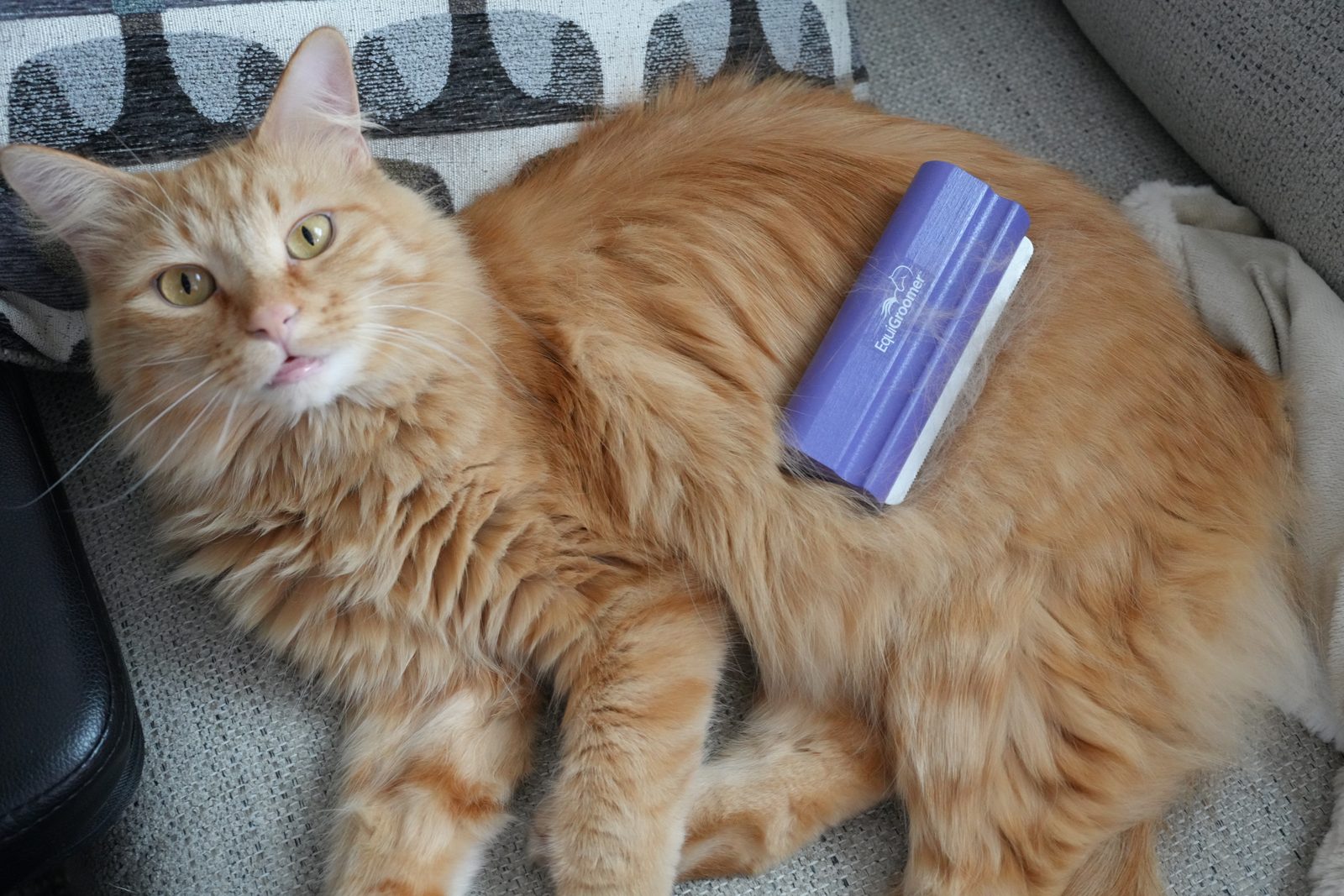
If you have a long-haired cat and you only buy one tool, buy the EquiGroomer 5 inch. If you can stretch to two, add a steel greyhound comb. That's the kit I've used on Herbie (orange longhair) and Luna (silver longhair) every couple of days for a year, and it's the answer to almost every brushing problem a longhair throws at you.
This is part of the main cat hair guide, broken out because long coats are a different problem from short coats and the tools that work on a tabby don't all work on a Maine Coon. The EquiGroomer pulls loose undercoat without dragging skin, the comb finds mats before they lock in, the FURminator earns a third spot for heavy molt on the cat that tolerates it. Three tools, $50 to $70 total, and you stay ahead of the shedding instead of chasing it.
The long coat problem
What's different about long-haired coats
A short-haired cat sheds and the loose hair lands on the couch. A long-haired cat sheds and the loose hair stays in the coat, gets tangled up with the topcoat, and turns into a mat behind a back leg in 2 weeks if you don't catch it. That's the whole difference. The shedding cycle is the same, the consequences are not.
Long coats also have a thicker, denser undercoat than the topcoat suggests. Herbie looks fluffy on top and has a layer of dense fluff underneath that you don't see until you brush him. That undercoat is the part that sheds, the topcoat is mostly stable. A good long-hair tool reaches the loose undercoat at the tips without yanking the topcoat or dragging the skin underneath.
And the skin under a longhair is sensitive. The coat insulates so well that the skin doesn't toughen up the way it does on a sleek shorthair. Press too hard with a wire-tipped slicker and you'll see scurf and irritation in a day. Press too hard with a sharp clipper-edge deshedder and you'll thin the coat. The tools that work on long-haired cats are the ones that grab hair at the tips and let go before they reach the skin.
The buying criteria
What to look for in a long-hair brush
Three things matter. Gentle on skin, reaches the undercoat, doesn't pull or tear the topcoat. Most brushes hit one or two of those, the right tools hit all three.
Gentle on skin means no sharp clipper edges and no bent wire pins. Serrated teeth that grab hair at the tips are gentle. Smooth steel comb teeth are gentle. Soft pin brushes are gentle. Slicker brushes with bent wire pins are not gentle, they're designed for dogs with thicker skin.
Reaches the undercoat means the tool actually picks up the dense layer of dead fluff under the topcoat. A pin brush or a soft brush moves the topcoat around but pulls almost no undercoat. The EquiGroomer's serration grabs loose undercoat at the tips. The FURminator's clipper edge digs deeper. A wide-toothed steel comb finds tangles in the undercoat that the deshedder missed.
Doesn't pull or tear the topcoat is what kills the slicker brush. Wire pins catch live topcoat hair as much as dead undercoat hair, the cat feels it, and the topcoat thins over time. The serration on the EquiGroomer is too short to grab live, anchored hair. A steel comb with rounded tooth ends slides past the topcoat and only catches when it hits a tangle.
Pick 1 • Best overall
The best brush for a long-haired cat: EquiGroomer 5 inch
The EquiGroomer was originally a horse grooming tool. The cat version is a 5 inch serrated edge set into a hardwood handle, that's the entire product. The teeth are short, they curve outward, and they're not bladed. They grab loose, dead hair at the tips and lift it without reaching down to the skin. That mechanism is exactly what a long-haired coat needs.
I bought it after Herbie started walking away from the FURminator at stroke 3. With the EquiGroomer he sits for the full 5 minutes, sometimes flops onto his side and asks for the other flank. Same story with Luna, who's shy and won't sit still long, the wider blade covers more coat per stroke so 2 productive minutes is enough. A 5 minute pass on Herbie pulls a softball-sized pile of loose undercoat. You can see the difference in the coat after one session.
$25 on Amazon. Hardwood handle, no moving parts, no blade to dull. Mine is over a year old and looks identical to the day I bought it. The full deep dive is on the EquiGroomer review, and the head-to-head with the FURminator is on the comparison page.
Pick 2 • Heavy molt
FURminator deShedding Edge for Cats
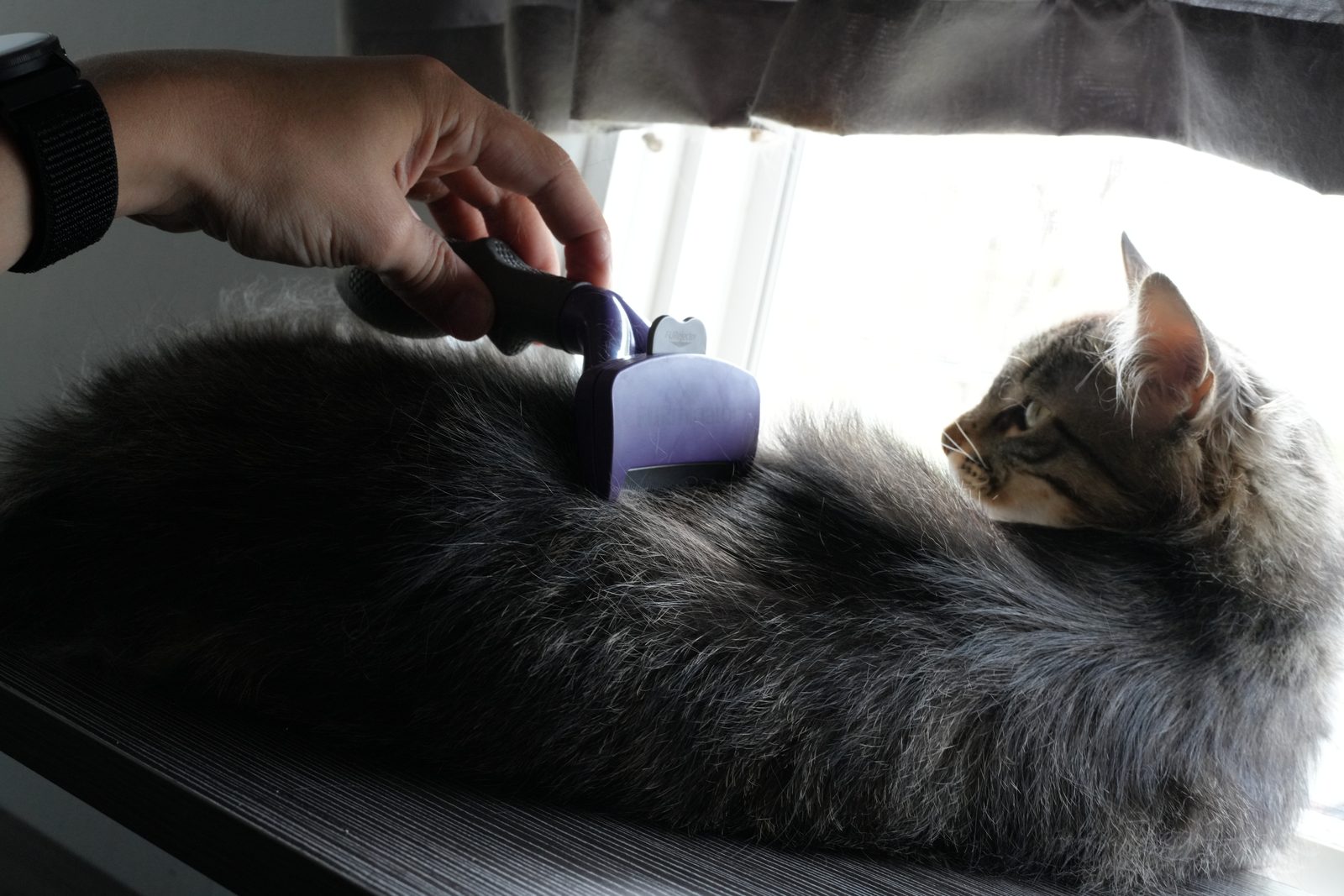
The FURminator is the best-built deshedder I've ever held. Stainless steel clipper-style edge, rubberized handle that doesn't slip, ejector button that flicks the pile of fur off the teeth in one motion. It pulls bigger chunks of undercoat per stroke than the EquiGroomer, that part of its reputation is earned. During spring molt the FURminator on Leo for 5 minutes lifts a visible amount of undercoat that the EquiGroomer would need 8 or 10 minutes to match.
The catch is the tug. The clipper-fine teeth reach down through the topcoat to the undercoat, which is why they pull more per stroke and why a sensitive cat feels every one. Herbie won't sit through it. Luna walks away in seconds. Leo tolerates it because Leo tolerates almost everything. On long-haired cats that aren't Leo, the FURminator is a once-a-week heavy-molt tool at most, never the daily driver.
Use it carefully. Light pressure, with the grain, skip the belly and the chin. Manufacturer documentation is explicit that overuse thins the coat and can abrade skin. For everyday brushing on a longhair, the EquiGroomer is the safer default. The full comparison is on FURminator vs EquiGroomer.
Pick 3 • Mat prevention
The best comb for long-haired cats: a greyhound steel pin comb
A greyhound comb is a 7 to 8 inch long stainless steel comb with two tooth widths, wider on one half and finer on the other. It's the standard professional grooming comb, you'll see it in every grooming kit at every salon. On long-haired cats the job is line combing, parting the coat in sections and combing through to the skin to find tangles before they lock into mats.
This is the tool the EquiGroomer can't replace. The deshedder grabs loose undercoat at the tips, but it doesn't reach into the dense layer where tangles form. Herbie gets a mat about every 10 days behind his back legs from sitting on hardwood and grooming himself. The greyhound comb finds it the next time I run through, holding the hair near the skin and combing the tip out first, the tangle works free in 30 seconds. Without the comb that mat would lock in, get bigger, and end up at a groomer with clippers.
I picked mine up for $15 at a pet store, the Resco and Chris Christensen brands are the standard, plenty of unbranded steel combs work fine. Run it through the belly, the armpits, behind the back legs, and around the ruff once a week. That's the whole protocol. The comb does for mats what the EquiGroomer does for shedding, it stays ahead of the problem instead of fixing it after the fact.
By breed
Breed-specific notes
The kit doesn't change much across long-haired breeds, but the cadence and the focus areas do.
Maine Coon. Bigger cat, thicker undercoat, more coat to get through per session. Plan on 10 minutes with the EquiGroomer instead of 5, and line comb the ruff and the britches twice a week instead of once. The FURminator earns its spot during the spring molt if your Maine Coon tolerates it, the volume of undercoat coming out justifies the heavier tool.
Ragdoll. Single-coat or thin double-coat, depending on the line. Most Ragdolls don't have the dense undercoat a Maine Coon has, so the EquiGroomer pulls less per stroke and the FURminator is overkill and risks thinning the coat. EquiGroomer plus comb is enough. Daily comb-through during shedding season catches mats early.
Persian. The longest, densest coat in the cat world. The EquiGroomer is still the right deshedder, but the comb does more of the daily work than it does on other breeds. Daily line combing is the standard maintenance, not a once-a-week thing. A Persian that goes 2 weeks without combing is a Persian getting shaved at a groomer.
Norwegian Forest Cat. Similar to a Maine Coon. Thick weather-resistant double coat, heavy seasonal molt. Same kit, same cadence as a Maine Coon. The undercoat blows out twice a year and the FURminator earns its keep during those weeks.
Siberian. Triple coat, very dense. Treat like a Norwegian Forest. The EquiGroomer's wide head is the right call here, the extra coverage matters when there's that much coat to get through. Comb the belly daily during molt, weekly otherwise.
More cat hair reviews coming
I'm working through the rest of the gear in my house: deshedders, robot vacuums, the bedding I switched to, plus the FurStopper Fan Filter I made for the fan-blade hair problem. Drop your email if you want updates when something earns a spot.
One-tap unsubscribe in every email. See the privacy policy.
Don't bother
What to avoid
Two categories of brush show up in every "best for long-haired cat" listicle and don't earn the spot.
Wire-pin slicker brushes. The bent metal pins catch as much live topcoat as dead undercoat, the skin under a longhair isn't tough enough for them, and they leave scurf if you press. The pile of hair on the slicker after a session looks like the brush is working, but a lot of that is yanked live hair, not shed undercoat. If a tool can't tell the difference between hair the cat is keeping and hair the cat is dropping, it's the wrong tool. Soft-pin slickers are gentler and have a place on dogs, on long-haired cats I'd still pick the steel comb.
FURminator on a single-coat cat. Some longhairs have very little undercoat (some Ragdolls, some Turkish Angoras, some mixed-breed longhairs). On those cats the FURminator's clipper teeth reach for an undercoat that isn't there and end up dragging across the topcoat and the skin. You'll thin the coat in a few sessions. Stick to the EquiGroomer and the comb. If you're unsure, lift the topcoat in a couple of spots, if there's no dense fluff underneath, skip the FURminator entirely.
Also skip rubber curry brushes for long-haired cats, the rubber pulls topcoat instead of undercoat, and skip "shedding gloves" for the same reason. They're shorthair tools. If you're deciding between all three, I put the FURminator, the EquiGroomer, and a cheap deshedding glove side by side on FURminator vs EquiGroomer vs deshedding glove.
At a glance
The 3 picks compared
| Tool | Best for | Cadence | Price | Verdict |
|---|---|---|---|---|
| EquiGroomer 5 inch | Daily deshedding on any longhair | Every 2 to 3 days, 5 minutes per cat | $25 | 5.0 / 5 |
| FURminator deShedding Edge | Heavy molt, cats that tolerate the tug | Once a week during shedding season | $30 | 4.0 / 5 |
| Greyhound steel comb | Mat prevention, line combing the belly and legs | Once a week (daily on Persians) | $15 | 4.5 / 5 |
Frequently asked
FAQ
What's the best brush for a long-haired cat?
The EquiGroomer 5 inch for daily deshedding plus a steel greyhound comb for line combing the belly and the back of the legs. The EquiGroomer pulls the loose undercoat at the tips without dragging skin, the comb finds tangles before they lock into mats. That's the kit I've used on Herbie (orange longhair) and Luna (silver longhair) for a year.
EquiGroomer vs FURminator for long-haired cats, which is better?
EquiGroomer for most longhairs. The wider serrated head covers more coat per stroke, the teeth grab the loose undercoat at the tips instead of digging to the skin, and there's no sharp edge to abrade. The FURminator pulls bigger chunks per stroke during heavy molt, but the tug is real and a lot of longhairs walk away from it. Buy the EquiGroomer first, add the FURminator later if your cat tolerates it during shedding season.
Is the FURminator safe for cats?
Yes if you use it carefully and infrequently. The clipper-style edge is sharp by design, the manufacturer warns against pressing hard or going over the same spot repeatedly, and overuse is documented to thin coats and abrade skin. On long-haired cats use light strokes in the direction of the fur, skip the belly, and limit sessions to once a week during heavy molt. For everyday brushing, the EquiGroomer is the safer default.
What brush should I use on a Maine Coon?
Same kit as any other longhair, an EquiGroomer for the deshedding pass and a steel greyhound comb for the dense undercoat around the ruff and the britches. Maine Coons are bigger and the coat is thicker than my Herbie's, so plan on longer comb-throughs and more frequent sessions during the spring molt. Skip slicker brushes, the wire teeth get caught in the topcoat and pull live hair.
How do you brush a long-haired cat without hurting it?
Three rules. Brush in the direction of the fur, never against it. Use a tool that grabs hair at the tips (EquiGroomer, comb) instead of one that drags across the skin (slicker, FURminator pressed hard). Stop after 5 minutes, even if there's still fur to pull. Treat after every session. Long coats hide tangles, so when the comb catches, work the tangle out by holding the hair near the skin and combing the tip first, never yank from the root.
Do I need a steel comb for a long-haired cat?
Yes. A deshedding tool pulls loose undercoat off the surface, but it doesn't find tangles forming deep in the coat. A long stainless steel comb (the greyhound style is the professional standard) lets you line comb through the belly, the armpits, and the back of the thighs to catch knots before they turn into mats. Once a week is enough on a well-maintained coat. Without it you'll find a mat the size of a walnut behind a leg one day and end up paying a groomer to shave it out.
Best comb for long-haired cats?
A greyhound steel comb is the best comb for long-haired cats, the same long stainless steel comb with two tooth widths that every groomer keeps in the kit. The wider half pulls through the bulk of the coat, the finer half catches the knots forming deep in the undercoat. Line comb the belly, the armpits, behind the back legs, and around the ruff once a week and you find tangles before they lock into mats. I paid $15 for mine and it's the other half of the kit alongside the EquiGroomer. Skip plastic combs, the teeth flex and skate over tangles instead of working through them.
What's the best brush for a cat that hates being groomed?
EquiGroomer, in 2 minute sessions, with treats. Two of my 3 cats walked away from the FURminator. Both sit through the EquiGroomer because the drag is gentler and there's no skin contact. If your cat still refuses, scale down. 30 seconds today, treat. 1 minute tomorrow, treat. Don't pin a cat for grooming, you'll burn the relationship and the brushing won't last.
How often should you brush a long-haired cat?
Every 2 or 3 days for 5 minutes with the deshedder, plus a quick line comb through the belly and behind the legs once a week. During spring and fall molt, daily if the cat tolerates it. Long coats compound, miss a week and you're chasing mats instead of pulling loose hair. Short and frequent beats long and rare every time.
Can you use a slicker brush on a cat?
I don't. Slickers are wire pin brushes designed for dogs, the bent metal tips scratch cat skin and yank live hair out of the topcoat. They look like they're working because hair piles up on the pad, but a lot of that is pulled live hair, not shed undercoat. Use an EquiGroomer or a steel comb on a long-haired cat. If you already own a slicker, soft-pin slickers exist and they're gentler, but I'd still pick the comb.
Brushing is the highest-leverage thing you can do about cat hair. Hair you pull off the cat is hair you don't have to chase off the couch later, the couch cleanup guide covers what to do with the rest. The EquiGroomer deep dive and the FURminator comparison have the full story on the two main tools above.
How I tested
The bar these had to clear
3 cats, 2 longhairs
Herbie (orange longhair, dense undercoat, the easygoing indoor cat), Luna (silver longhair, shy, outdoor rescue from the backyard), Leo (grey tabby shorthair, Luna's brother, also a backyard rescue). Two long-haired test subjects with different coats and different tolerances for being brushed.
A year of regular use
EquiGroomer in rotation 2 to 3 times a week per cat for over a year. FURminator pulled out for heavy molt sessions on Leo. Greyhound comb run through Herbie's belly and back legs once a week, more often when he's been wrestling Leo on hardwood.
Bought at retail
Paid $25 for the EquiGroomer, $30 for the FURminator, $15 for the comb. No review units, no freebies. Same tools anyone reading this can buy on Amazon or at any pet store.