Cat Breeds That Shed the Most (and the Least)
This is the question I get asked most. I don't own a purebred, so I'm answering it by coat type and what owners and breeders report, not by pretending I've lived with a Maine Coon.
First, the honest part. I own 3 cats and all 3 are mixed-breed: Leo, Luna, and Herbie. None of them is a Maine Coon or a Persian or a Siberian. So this is the question I get asked most, answered the only honest way I can answer it, by coat structure and what owners and breeders consistently report, not by me claiming first-hand years with breeds I've never lived with.
This is part of the cat shedding cluster. Here's the thing I can speak to directly: coat structure drives shedding far more than breed name or hair length. A double coat sheds more than a single coat, and the dense undercoat is what blows out during molt. I know that part first-hand, because 2 of my mixed-breed cats, Herbie and Luna, carry that double-coat structure. So I'll reason from coat type, slot the well-known breeds into the pattern, and tell you plainly where I'm going on reputation instead of experience.
The real driver
Forget the breed name. Look at the coat.
Almost every "does this breed shed a lot" question has the same underlying answer, and it's not about the breed at all. It's about whether the cat has a single coat or a double coat. A single coat is one layer of hair. A double coat is a longer protective topcoat over a dense, soft, insulating undercoat, and that undercoat is the thing that releases in handfuls during the spring and fall molts.
Coat length matters less than people expect. Long hair makes the shed fur more visible, but the rate of hair loss is set by the undercoat. A short-haired British Shorthair with a plush double coat can drop more total hair than a single-coated longhair. I see it at home: Leo is a short-haired grey tabby and sheds a steady amount year-round, while Luna's longer silver coat looks like 3 times the shedding when the real difference is mostly hair length. The mechanics are in why is my cat shedding so much.
So the pattern in the breed groups below is simple. Dense double coat, heavy shedder. Single coat or very short coat, lighter shedder. Hairless, no shed fur but its own care routine. That holds up across nearly every breed, which is why I'm comfortable reasoning from it instead of pretending to have owned each one.
The quick reference
Cat breeds by shedding level
Here's the scannable version. Shedding tendency, the common breeds in each group, and the one-line coat reason behind it. These are widely-accepted general tendencies, not measured statistics, and individual cats vary.
| Shedding level | Breeds | Why (coat type) |
|---|---|---|
| Heavy | Maine Coon, Persian, Norwegian Forest Cat, Siberian, Ragdoll, Ragamuffin, Himalayan | Long, dense double coats with a heavy undercoat that blows out hard in spring and fall. |
| Moderate | British Shorthair, American Shorthair, Russian Blue, Domestic Shorthair, Domestic Longhair | Plush or medium double coats. Shorter hair hides it, but the undercoat still sheds steadily. |
| Low | Siamese, Oriental Shorthair, Bengal, Burmese, Tonkinese, Cornish Rex, Devon Rex | Single coats or very fine short coats with little to no undercoat, so far less hair to drop. |
| Hairless | Sphynx | Essentially no coat, so no loose fur. Trades shedding for regular skin and bathing care. |
The heavy group
The breeds that shed the most
The heaviest shedders are the big, fluffy, double-coated breeds: Maine Coon, Persian, Norwegian Forest Cat, Siberian, Ragdoll. All of them carry a thick undercoat and all are consistently reported by owners and breeders as high-maintenance coats. Maine Coons come up constantly in the "do they shed a lot" searches, and the answer is yes, a lot, with a shaggy water-resistant double coat that releases heavily during molt. Persians are the extreme on the grooming end, dense enough that daily combing is standard, not optional. Norwegian Forest Cats and Siberians have the same heavy cold-climate double coat that blows out dramatically when the weather warms.
I'm going on reputation and coat science here, not personal experience with these specific breeds. What I can tell you from my own house is what a double coat does, because Herbie and Luna both have one in mixed-breed form. Every spring I pull softball-sized piles of undercoat off each of them, and a purebred Maine Coon owner is dealing with that same mechanism scaled up. If you're bringing one of these home, plan the brushing routine before the cat arrives, not after the first molt surprises you.
The middle group
The moderate shedders
The middle of the table is where most everyday cats land, including the two most common cats in the world, the domestic shorthair and the domestic longhair, which is what my 3 actually are. British Shorthairs and American Shorthairs have plush double coats that shed steadily, and because the hair is short people underestimate how much is coming off. Russian Blues have a famously dense plush double coat, and while they're sometimes marketed as low-shedding, the undercoat is real and they shed more than the marketing suggests.
This is the group where coat length fools people most. A British Shorthair looks low-maintenance because the hair is short and tidy, but the dense undercoat drops a steady volume year-round. Short hair hides the shed, it doesn't reduce it. My grey tabby Leo is a textbook moderate shedder: even year-round shed, never dramatic but always there on the dark furniture.
The light group
The breeds that shed the least
If low shedding is your priority, look for single coats and very fine short coats. Siamese and the related Oriental Shorthair have sleek single coats with little undercoat, so there's simply less hair to lose. Bengals have a short, fine, pelt-like coat that sheds noticeably less than a plush double coat, and Burmese and Tonkinese sit in the same lighter range. The Rex breeds are the interesting case: Cornish Rex and Devon Rex have soft, curly, sparse coats with reduced hair layers, so very little shed fur lands on your furniture. They still shed, every cat with hair sheds, the volume is just low.
One honest caveat: low-shedding does not mean no-grooming, and it does not mean allergy-proof. The light coats still benefit from a weekly once-over, and the curly Rex coats can need help managing skin oils. If you're choosing a cat specifically to cut down on hair, the lighter breeds genuinely help, but pair that with the right tool and a routine. The general playbook for any coat is in how to reduce cat shedding.
The hairless case
Sphynx: hairless, but not maintenance-free
The Sphynx is the breed people reach for when they want zero shed hair, and on that specific point it delivers. There's essentially no coat, so there's no loose fur on the furniture. But hairless is a trade, not a cheat code. The skin oils a coat would normally absorb build up directly on the bare skin instead, so Sphynx cats are typically bathed regularly and need routine ear and skin cleaning. A Sphynx swaps the loose-fur problem for a skin-care routine. And, again, hairless does not mean hypoallergenic, which is the single most common misconception about this whole topic.
The allergy myth
No cat is truly hypoallergenic
This is the one I want people to leave with. No cat is genuinely hypoallergenic. The main thing people react to isn't cat hair at all, it's a protein called Fel d 1, and it's produced in the cat's saliva and skin glands, not in the fur. When a cat grooms, it spreads that protein all over its coat, and when the coat-coated hair dries and flakes off as dander, that's what floats around and triggers allergies.
That's why a low-shedding or hairless cat can help an allergy sufferer at the margins. Less shed hair means less allergen-carrying material drifting through the air. But the allergen itself is still being produced on the skin and in the saliva of every cat, including a Sphynx. Some lines, certain Siberians in particular, are anecdotally reported to make less Fel d 1, but that's an individual-cat thing and not a guarantee you can buy your way into.
If allergies are the actual problem you're trying to solve, breed choice is a minor lever. The bigger levers are managing the dander in the air and on surfaces. That's a whole topic of its own, and I've covered the airborne side in cat hair in the air, which gets into dander, air movement, and why the floating stuff is the part that gets up your nose. This page is about shedding, not medicine, so if you have a serious allergy talk to a doctor before you choose a cat based on it.
Coat and shedding notes, no spam
I send a few emails a year, mostly when something earns a spot or when seasonal molt is about to land and brushing cadence needs to change. Drop your email if you want the updates.
One-tap unsubscribe in every email. See the privacy policy.
Whatever you've got
Managing the shed, heavy coat or light
Here's where my actual experience is useful, regardless of breed. The shedding from any double-coated cat comes down to the same routine I run on my own mixed-breed longhairs. Brush 2 or 3 times a week with a real deshedder, daily during the spring and fall molt windows, and the bulk of the loose undercoat ends up on the brush instead of on the couch.
For a heavy double coat, the tool matters more than the schedule. The comparison I keep pointing people to is FURminator vs EquiGroomer, because those are the two deshedders that actually reach the undercoat. If you've got one of the heavy-shedding longhair breeds from the top of the table, the breed-specific cadence and the kit I'd use is in the best brush for long-haired cats. A Persian or a Maine Coon needs more frequent line combing than my longhairs do, but the principle is identical: get the dead undercoat out on your schedule, not the cat's. The full breakdown of what's normal and when shedding is actually a vet issue is in why is my cat shedding so much. Pick the cat whose coat you're willing to maintain, then maintain it. That's the whole game.
Frequently asked
FAQ
What cat breeds shed the most?
The heavy shedders are the dense double-coated breeds. Maine Coon, Persian, Norwegian Forest Cat, Siberian, Ragdoll, Ragamuffin, and Himalayan all carry a thick insulating undercoat under a longer topcoat, and that undercoat is what blows out in volume during spring and fall molt. Owners and breeders consistently report these as the highest-maintenance coats. It is the structure that drives it, a double coat sheds more than a single coat regardless of length. I do not own any of these breeds, but my two mixed-breed longhairs, Herbie and Luna, have the same double-coat pattern in miniature.
Do Maine Coons shed a lot?
Yes. Maine Coons are widely reported to be among the heaviest-shedding pet cats. They have a long, shaggy, water-resistant double coat with a dense undercoat, and that undercoat releases in large amounts during the spring and fall molts. Owners typically describe daily or every-other-day brushing during molt season to keep up. I have not lived with a Maine Coon, so I am going on what owners and breeders consistently say plus what I know about double coats from my own longhairs. The takeaway is simple, expect a lot of hair and a regular brushing routine, not a hands-off cat.
What cat breeds shed the least?
The lightest shedders are single-coated and short-haired breeds. Siamese, Oriental Shorthair, Bengal, Burmese, Tonkinese, and the Rex breeds (Cornish Rex, Devon Rex) all shed noticeably less than a dense double-coated cat. They still shed, every cat with hair sheds, but the volume is lower because there is little or no undercoat to release. The Sphynx is effectively hairless so there is no shed hair to manage at all, though that comes with its own skin and bathing care.
Are there hypoallergenic cats?
No, not truly. No cat is genuinely hypoallergenic. The main cat allergen is a protein called Fel d 1, and it is produced in saliva and skin glands, not in the hair itself. Cats spread it onto their coat when they groom, so a low-shedding or hairless cat puts less allergen-coated hair into the air, which can help some allergy sufferers, but the allergen is still there on the skin and in the saliva. Some lines, like certain Siberians, are anecdotally reported to produce less Fel d 1, but that is individual and not guaranteed. The dander-and-air angle is covered in cat hair in the air.
Does coat length determine how much a cat sheds?
Not as much as people think. Coat structure matters more than coat length. A short-haired cat with a dense double coat, like a British Shorthair, can shed more total hair than a single-coated longhair. Long hair makes the shed fur more visible because each strand is longer and clumps more, but the rate of hair loss is driven by whether the cat has a thick undercoat. Double coat equals heavy shed, single coat equals lighter shed, and length mostly changes how obvious it looks on your couch.
Do Sphynx cats need grooming if they are hairless?
Yes, just a different kind. A Sphynx does not shed hair onto your furniture, but the skin oils that a coat would normally absorb build up on the bare skin instead. Sphynx cats are usually bathed regularly to manage that, and their skin and ears need routine cleaning. So hairless solves the loose-fur problem and trades it for a skin-care routine. It is not a no-maintenance cat, it is a different maintenance cat.
The breed you pick decides how much hair you sign up for, but the coat decides it more than the name does. Pick a coat you're willing to brush. The routine that keeps any of them ahead of the shed is in how to reduce cat shedding, and the tool I keep coming back to is in the FURminator vs EquiGroomer comparison.
How I know
The basis for this page
3 mixed-breed cats, not purebreds
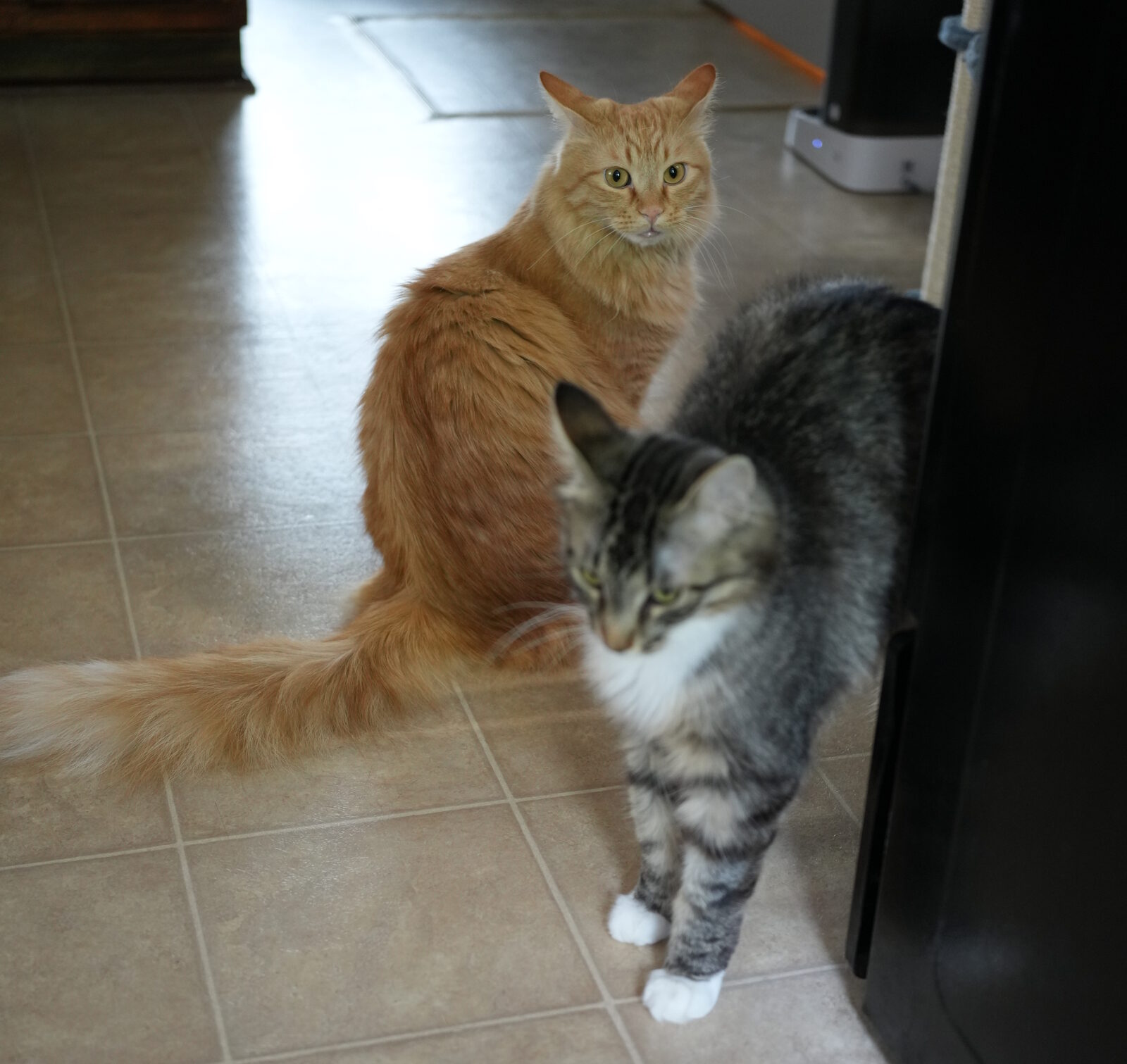
Leo (grey tabby shorthair), Luna (silver longhair), and Herbie (orange longhair). All mixed-breed. I do not own and have not lived with any of the purebreds named here, and I say so wherever it matters.
Reasoned from coat structure
The single-vs-double-coat framing is something I deal with directly. Two of my cats carry the double-coat pattern, so the heavy-shedder logic is grounded in what I actually brush out every spring, scaled to the breeds.
Breed tendencies, not invented stats
The breed groupings reflect widely-accepted general tendencies that owners and breeders report. There are no fabricated shedding numbers here, and no medical claims. Individual cats vary. For allergies, see a doctor.