Best Pillowcases for Cat Hair: 3 Picks That Actually Let Hair Go
Pillowcases are the cheapest, highest-impact bedding swap for cat hair. $15 satin, $30 bamboo sateen, $55 nylon. Skip the brushed microfiber.
REST Evercool+ pillowcases. They come with the sheet set. Or just buy satin if you're not ready to replace the rest of the bed. That's the whole listicle, and the rest of the page is me showing my work.
This is part of the bedding guide, broken out because pillowcases are the single piece of the bed where one $15 swap pays for itself in a week. They touch your face, they show hair immediately, they're the cheapest thing on the bed to replace. If you do nothing else from the bedding guide, do this.
The case for starting here
Why pillowcases are the best place to start
If your whole bed is brushed microfiber, you're going to want to replace the whole bed eventually. But the bed is $200 to $400 of fabric to swap all at once, and most people aren't doing that on a Tuesday. Pillowcases are different. A pair of satin pillowcases is $15. A pair of bamboo sateen is $25. The REST nylon pair runs about $55 if you buy them with the sheet set, which is what I did.
Pillowcases are also where cat hair shows up the loudest. They touch your face every night, they're the closest piece of bedding to your eyes when you wake up, and they're a flat surface so a single dark hair on a light pillowcase is unmissable. The rest of the bed has folds and shadows, the pillow does not. Fix the pillowcases first and the bed reads cleaner before you've spent a dollar on the sheets.
And the swap is reversible in 30 seconds. Satin pillowcase didn't suit you, fine, the satin pillowcase goes in the closet and the old one goes back on. Replacing the whole bed is a weekend. Replacing pillowcases is a coffee break.
The fabric rules
What to look for in a cat hair resistant pillowcase
Same rules as the rest of the bed. Smooth, tightly woven, low-static. The fabric has to be slick enough that hair has nothing to anchor into. The full breakdown is in the bedding guide's fabric science section, but the short list for pillowcases:
- Slick nylon or polyamide. The REST family. Smoothest of the lot, lowest hair retention, also the most expensive. Hair lifts off with a hand pass.
- Satin (synthetic weave). The cheap option that wins on dollars-per-result. $15 a pair, hair brushes right off, low static.
- Mulberry silk. Same physics as satin, gentler on skin and hair, $50 to $100 a pair. For cat hair specifically, satin is the better buy.
- Bamboo viscose with a sateen finish. Smooth, low-static, breathes better than synthetic satin. $20 to $35 a pair.
- High-thread-count percale (400+). Tight cotton weave, crisper than satin. Hair brushes off, just not as fast.
What to avoid is everything fuzzy. Brushed microfiber is the obvious one and the most common bedding fabric in the country, which is why this is a problem at all. Flannel, jersey knit, fleece, and "ultra-soft" anything all behave the same way. If the pillowcase feels velvety when you run a finger across it, the hair has somewhere to go.
Pick 1 • Best overall
REST Evercool+ Pillowcases (sheet set bundle)
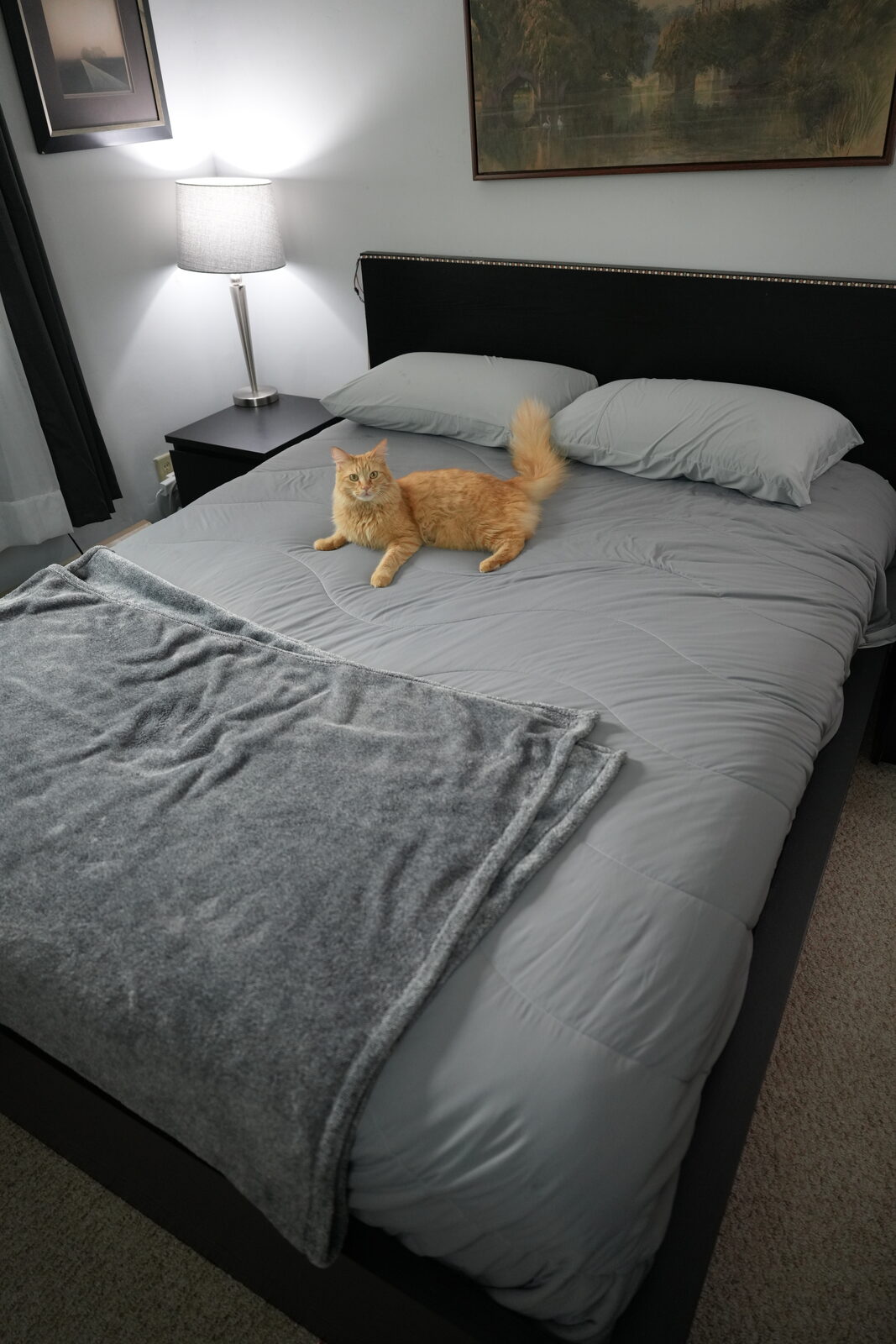
I've slept on the REST Evercool+ pillowcases for a year. They ship as part of the queen sheet set, two pillowcases included, same nylon-spandex weave as the fitted and flat sheet. The fabric is the slickest thing I've put on a pillow, and the hair behavior is what I came for. Herbie is the orange longhair in the photo, he sheds like a department store rug, his head is on my pillow most nights. In the morning I run a hand across the pillowcase, the hair lifts in a clump, into the trash, done.
Compared to the brushed microfiber pillowcases I had before, this is a different category. The microfiber pair would come out of the dryer still showing hair, baked into the surface. The REST pair come out clean, the hair ends up in the lint trap where it belongs. Same washer, same cats, different fabric. That's the whole story.
The honest gripe is you can't buy them as a standalone pair, at least not easily. They're a sheet-set bundle, the queen is $220 MSRP and goes on sale to $170 fairly often. If you only want pillowcases, this isn't the cheapest path. If you're already replacing the sheets, the pillowcases are the easiest add-on of the bunch. Read the full REST Evercool+ Sheets review for the long version.
Pros
- Slickest fabric of the 3 picks, hair brushes off in 5 seconds
- Anti-snag, anti-pilling, a year in with 3 cats and no damage
- Cool-touch, REST quotes Qmax 0.36 vs 0.11 cotton
- Comes with deep-pocket sheets, full-bed match
Cons
- Bundled with the $220 sheet set, hard to buy solo
- Slick feel takes a couple of nights to adjust to
- Limited colors, mostly muted neutrals
Pick 2 • Best budget / satin alternative
Satin or Silk Pillowcases (Blissy or generic satin)
Satin is the cheap, high-impact pillowcase swap. A 2-pack of synthetic satin from a generic brand on Amazon is $15. Blissy mulberry silk is closer to $50 a pair. Both work on the same physics as the REST nylon, just at a fraction of the price for the synthetic version. If you're walking past my brushed microfiber pillowcases on a budget, satin is where I'd send you.
Caveat up front, I haven't tested Blissy specifically. I've tested the slick-fabric principle for a year on the REST pair, and I've used satin pillowcases in years past before the REST swap. The behavior is the same. Hair lands, hair brushes off, hair doesn't embed. The fabric is doing the work, brand is mostly down to feel and durability of the seams.
The trade-offs vs the REST pair. Satin doesn't have the cool-touch math, it's room temperature like cotton. The fabric is a little less durable in the wash, generic satin will pill or wear thin after a year of weekly washes, mulberry silk lasts longer but costs 3 times as much. And the slick is more pronounced, some people slide off the pillow at first. None of which matters if the alternative is a microfiber pillowcase that's been actively producing hair for 6 months.
Pros
- $15 a pair for synthetic satin, lowest barrier to entry
- Hair brushes off, low static, same physics as nylon
- Gentler on hair and skin (silk especially)
- Easy reversible swap, the pillowcase is the only change
Cons
- Synthetic satin pills or wears thin after a year of weekly wash
- No cool-touch, room temperature like cotton
- The slick is pronounced, some sleepers slide off the pillow
- Tested in concept, not this exact brand
Pick 3 • Best bamboo / breathable
Bamboo Sateen Pillowcase
Bamboo sateen is the option I'd buy if I wanted a pillowcase that breathes like cotton, slips less than satin, and still beats microfiber on cat hair. Cariloha, Ettitude, and California Design Den all sell pillowcase pairs in the $20 to $35 range. The fabric is bamboo viscose with a sateen weave, which means a smooth surface laid over a naturally low-static fiber.
I haven't owned a bamboo pillowcase pair specifically, I've owned bamboo sateen sheets in a previous setup and the cat hair behavior was consistent with the fabric science. Hair brushed off, didn't embed, didn't survive a wash. For the pillowcase pick, I'm putting it on the list as researched-not-owned because the bamboo sateen category is well documented and the principle is the same as the bedding guide's fabric rules. The full bedding guide goes deeper.
The one thing to be careful about is the labeling. Brushed bamboo and ultra-soft bamboo are bamboo blends finished to feel like microfiber, which means they grab hair like microfiber. Same trap as brushed microfiber itself, just with a more natural-sounding label. Read the product description, look for "sateen weave," and skip anything that calls itself brushed.
Pros
- Smooth sateen surface, hair brushes off cleanly
- Naturally low-static, doesn't pull hair the way polyester does
- Breathes better than synthetic satin or nylon
- Less slippery than satin, more sleeper-friendly
Cons
- Researched not owned for pillowcases specifically
- Easy to get tricked by "brushed bamboo" labels (avoid)
- $20 to $35 a pair, more than synthetic satin
- Still wrinkles like cotton out of the dryer
More bedding picks coming
I'm still testing more pillowcases, mattress protectors, and slick blanket throws. Drop your email if you want updates when something earns a spot here.
One-tap unsubscribe in every email. See the privacy policy.
The trap
What to avoid: brushed microfiber pillowcases
Brushed microfiber is the worst common pillowcase fabric for cat hair. It's also the most common pillowcase fabric in the country because it's cheap and feels soft in the package. A brushed microfiber pair is $10 at Target. That's why most beds have it, and that's why most beds look hairier than they need to.
The thing about brushed microfiber that I didn't appreciate until I retired mine, is that the fabric stores hair inside the weave. After a few wash cycles the pillowcase has hair distributed through the surface, not just sitting on top of it. I've taken brushed microfiber pillowcases off the bed, washed them on hot, dried them on hot, put them in a closet for 6 months, taken them back out, and they were still producing hair onto a fresh pillow within a week. The fabric is a hair archive. Once it's saturated, it never stops.
The fix is replacement, not better washing. Donate the pair, buy satin, the bed reads cleaner the first night. The full case for why this fabric is the worst is in the bedding guide.
At a glance
The 3 picks side by side
| Pick | Fabric | Price | Hair retention | Tested |
|---|---|---|---|---|
| REST Evercool+ | Nylon-spandex | ~$55 (sheet set bundle, $220 set) | Lowest, hair brushes off in 5 seconds | 1 year, owned |
| Satin / Silk | Synthetic satin or mulberry silk | $15 to $50 a pair | Low, very close to nylon | Concept tested, not Blissy specifically |
| Bamboo Sateen | Bamboo viscose, sateen weave | $20 to $35 a pair | Low, slightly more friction than satin | Researched, not owned for pillowcase |
| Brushed microfiber (avoid) | Polyester microfiber | $10 a pair | Worst common fabric, holds hair through wash | Owned for years, retired |
The pattern is the price floor. $15 satin already does most of the work of the $55 nylon. The premium gets you cool-touch, anti-snag, and full-bed fabric matching, none of which is required for the cat hair fix.
Frequently asked
FAQ
What's the best pillowcase to keep cat hair off?
Slick nylon, satin, mulberry silk, or bamboo with a sateen finish. All four are smooth and low-static so hair brushes off instead of embedding. The REST Evercool+ pillowcases that come with the sheet set are my daily driver in a 3-cat house, and a $15 satin pair from any decent brand works on the same principle.
Do satin pillowcases really repel cat hair?
They don't repel hair, hair still lands on them. The point is hair has nothing to anchor into. Satin is a tight, smooth weave with low friction, so a hand pass clears the pillow in 5 seconds. Compared to a brushed microfiber pillowcase, satin holds a fraction of the hair. Same physics as a slick nylon sheet, just a lot cheaper.
Are bamboo pillowcases good for cat owners?
Yes, if the bamboo has a smooth sateen finish. Bamboo viscose is naturally low-static and the sateen weave puts a smooth face on the fabric, so hair brushes off cleanly. Avoid anything labeled brushed bamboo or ultra-soft bamboo. Those are bamboo trying to feel like microfiber, and they grab hair the same way microfiber does.
Will replacing only pillowcases make a real difference?
Yes, more than any other single bedding swap. Pillowcases touch your face every night, they show hair immediately, and they're the cheapest piece of the bed to replace at $15 to $30 a pair. A brushed microfiber pillowcase is the worst common bedding fabric for cat hair, swapping it for satin or nylon is the highest impact-per-dollar move you can make.
Why does brushed microfiber pillowcase grab cat hair?
The brushed surface is a forest of tiny lifted fibers up close, and every cat hair gets multiple anchor points to hook into. The fabric is also static-prone in dry air, which actively pulls hair toward it. After a few wash cycles a brushed microfiber pillowcase will keep producing hair from inside the weave even after you've retired it. The fabric stores hair the way a vacuum bag does.
Can you machine wash satin pillowcases?
Yes, cold wash, gentle cycle, low or no heat in the dryer. A mesh laundry bag protects the fabric from snags. Skip fabric softener, it leaves a film that kills the slick feel that's doing the cat-hair work. Mulberry silk pillowcases want the same treatment but air-dry to be safe.
How often should you wash pillowcases when you have cats?
Once a week minimum, twice if a longhair sleeps on your pillow. Pillowcases collect hair, skin oil, and dander faster than the rest of the bed because they're right under your face. With slick fabric the visible hair brushes off between washes, but the wash itself still matters for the dander side of the equation.
What's the difference between satin and silk pillowcases for cat hair?
For cat hair, basically nothing. Both are smooth, both are low-static, hair brushes off both. Silk is the natural fiber, costs $50 to $100 a pair, and is gentler on hair and skin. Satin is the synthetic weave, costs $15 to $25, and lasts longer in the wash. If cat hair is the only problem you're solving, satin is the better dollar.
Do pillow protectors help with cat hair?
A protector under the pillowcase doesn't help with surface hair, but a smooth woven protector keeps hair and dander out of the actual pillow, which extends the pillow's life. The pillowcase on top is still where the hair fight happens. Pick the protector for the pillow, pick the pillowcase for the hair.
Pillowcases are the easy win. The harder problem is the rest of the bed, and that's a longer fight. The matching REST Evercool comforter review covers the top layer, the REST Evercool+ sheets review covers the fitted and flat, and the best cat hair resistant comforter listicle compares the duvet options. For laundry-side fixes, the remove cat hair from bedding how-to covers the dryer trick and FurZapper discs.
How I tested
The bar this list had to clear
A year on the REST pair
Bought the REST Evercool+ sheet set at retail for $170, two pillowcases included. Slept on them for a year through 3 cats and 2 longhairs. Weekly washes, summer to summer.
Years on brushed microfiber (the worst case)
Used brushed microfiber pillowcases for years before the REST swap. Tracked the hair behavior wash after wash. Retired them when I figured out the fabric was the problem, not the cleaning routine.
Satin and bamboo flagged honestly
Satin tested in concept, not Blissy specifically. Bamboo sateen pillowcase researched not owned. Both labeled where they sit, both included because the fabric science is consistent with the bedding guide.