Air Purifier vs Fan for Cat Hair: Which Catches More?
An air purifier moves 200 to 400 CFM and is built for microscopic dander. A pedestal fan moves 2,500 and can catch the visible hair. They're not the same tool, the question is which one your house is missing.
If you Googled "best air purifier for cat hair," you bought into a frame the air purifier industry doesn't want to correct: that an air purifier can do something about the visible hair on your couch, your floors, and your fan blades. It can't, not really. Air purifiers are built for microscopic particles. Cat hair is enormous by their standards.
The good news is that the tool you actually need for visible hair is already in your house, you just don't know it. It's a fan. Any fan. Pedestal, table, floor, doesn't matter. With the right cover on it, a fan moves 3x to 8x more air per minute than the most expensive consumer air purifier and catches hair on the way through. The math takes about 3 paragraphs to explain and once you see it you can't un-see it.
The whole argument in one chart
The particle size gap is the whole argument
Air purifiers are built around a particle size range. True HEPA filters are rated to capture 99.97% of particles at 0.3 microns, and they get even better above and below that size. The whole machine is engineered to pull air past that filter and trap small stuff: dander (2 to 10 microns), Fel d 1 (rides on dander), pollen (10 to 100 microns), dust mite debris (10 microns), smoke (under 1 micron).
Cat hair is in a different category entirely. A single strand is 50 to 100 microns thick and centimeters long. Imagine a HEPA filter as a fine net designed to grab grains of sand, then ask it to catch a piece of yarn. The fiber doesn't fit through the path the purifier uses, the air can't carry the hair into the intake from across the room, and even if a strand somehow got pulled in, it would clog the pre-filter and shorten its life by weeks.
| Particle | Size | Caught by |
|---|---|---|
| Smoke | 0.3 to 1 micron | True HEPA |
| Dander, Fel d 1 | 2 to 10 microns | True HEPA |
| Dust mite debris | 10 microns | True HEPA |
| Pollen | 10 to 100 microns | True HEPA pre-filter |
| Cat hair (single strand) | 50 to 100 microns thick, centimeters long | Mesh on a fan |
Read down that last column and the question answers itself. Two different particles, two different tools. The air purifier industry has spent a decade marketing themselves as a cat hair solution because it sells units, and the truth is they're great at the job they're designed for, dander, but that job isn't the same as the visible hair on your couch.
The CFM math
The airflow gap is the next argument
Even if you ignore the particle size question, there's an airflow gap nobody talks about. CFM (cubic feet per minute) is the unit of how much air a machine moves past its intake. More CFM means more air sampled per minute, which means more particles encountered per minute, which means more chances to catch the hair drifting through your house.
| Machine | Approx CFM | Built for |
|---|---|---|
| Bedroom air purifier (LEVOIT Core 300S) | ~140 CFM | Small room dander |
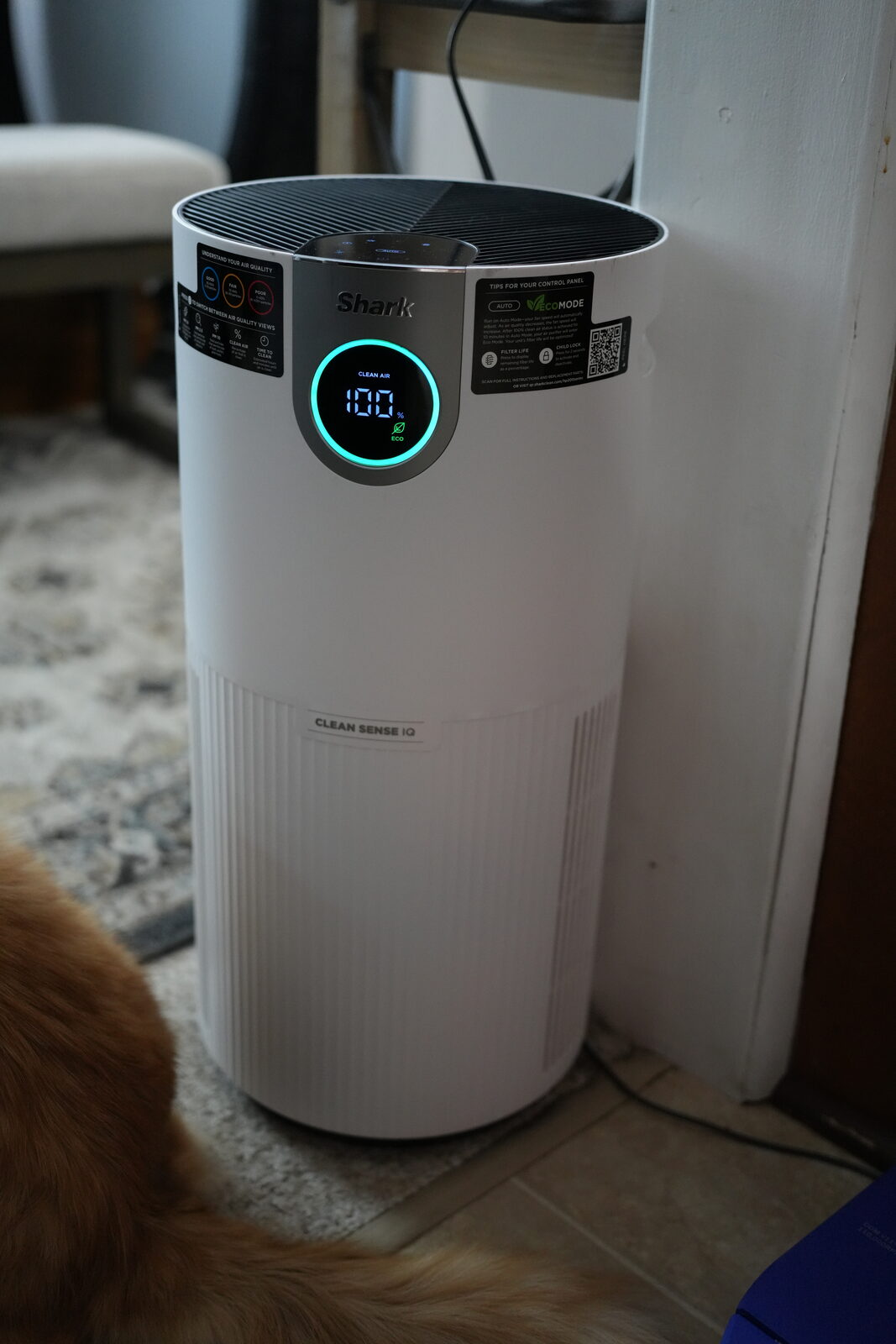
| Living room air purifier (Shark HP200) | ~300 CFM | Open floor plan dander |
| Pedestal fan | 1,200 to 2,500 CFM | Cooling a room |
| 18 inch high velocity floor fan | 1,900 to 3,600 CFM | Garage, workshop, hot rooms |
A pedestal fan moves 5x to 10x more air per minute than the air purifier you're considering buying. A high velocity floor fan can move 12x more. None of those fans were designed to be hair catchers, that's why people are mad at them in the first place, the hair was caking on the blades and getting blown back into the room. With a Fan Filter on the front, the same fan keeps moving the same volume of air, except now the hair lands on the mesh instead of the blades.
The lesson here is the boring one and it's the one that matters: if you want to catch hair drifting in your house, the right tool moves more air per minute. The fan you already own is the higher CFM machine in any room. The Fan Filter is what gives the air a place to deposit the hair.
The receipts
The cost gap is the part that actually decides the question
Run the numbers. A decent True HEPA air purifier rated for an open floor plan runs $250 to $350. A great one (the Shark HP200, which I own) is around $300. Filter replacements are $50 to $60 every 6 to 12 months. Five year cost: roughly $500 to $800 for one unit covering one main room.
A multipack of FurStopper Fan Filters covers every household fan in a typical house with covers to spare. The mesh is washable, you rotate them, you don't throw filters in the trash. The only ongoing cost is the price of the fans you already own.
So the comparison isn't the same job at two price points, it's $300 to $800 for catching dander you can't see and a fraction of that for catching hair you can. Two different jobs, two different price points, and they happen to be priced exactly inversely to how often most people need them. Most people need the hair tool more often than the dander tool, and it's the cheaper one. The market just hasn't caught up.
When the purifier wins
When the air purifier is the right answer
Cat allergies in the house. The Fel d 1 protein rides on dander particles, dander is exactly the size True HEPA filters are designed to catch, and HEPA studies show meaningful reductions of Fel d 1 in sealed rooms with a properly sized purifier running continuously. If anyone in your house has a real cat allergy, a True HEPA purifier in the room they sleep in is medical-grade-relevant gear, not optional.
Smoke or cooking. Carbon Odor Lock layers in the better units (Shark HP200, LEVOIT Core 300S, Coway Mighty) clear out cooking smell, smoke, and litter odor in minutes. The Fan Filter does nothing for any of that, it's a mesh, not a chemical filter.
The fine particle haze you can see in a sunbeam. That's dust, dander, and combustion particles, all microscopic. A purifier in the room flattens that haze on auto mode in maybe 20 minutes. A fan with a Fan Filter wouldn't touch it, the mesh is too coarse.
The unit I run is the Shark HP200, full review there, and the head-to-head with the smaller bedroom unit is Shark HP200 vs LEVOIT Core 300S. Both are solid picks for what air purifiers are actually for.
When the fan wins
When the fan with a Fan Filter is the right answer
Visible hair on the couch, on your clothes, on the floor. That's hair-sized particles, the wrong job for a HEPA filter, the right job for a mesh on a fan that's already moving thousands of CFM through the room.
Caked fan blades. The fan in your living room is full of dust and hair right now, you know exactly what I'm talking about. A Fan Filter is the only thing that fixes the root cause: hair lands on the mesh on the outside instead of getting pulled into the blades. You vacuum the mesh or wash it, never disassemble the fan again.
Hardwood floors that look dirty an hour after you vacuum. Hair on hard surfaces drifts at the slightest air current. A floor level fan with a Fan Filter pulls air through the bottom 18 inches of the room and catches the hair while it's drifting. I have a separate guide on cat hair on hardwood floors with the full setup.
Multiple cats, multiple rooms, multiple fans. The air purifier scales linearly, one unit per room, $250 to $350 each, $1,000 plus to do a four bedroom house. Fan Filters barely scale at all. Same number of rooms, every fan covered, for a fraction of one purifier. The economics aren't close.
The Fan Filter is the FurStopper original.
The setup that actually works
Why most cat houses need both
The frame "air purifier vs fan" is wrong. They aren't competing for the same job, they're complementary tools for different problems. The air in your house has both kinds of particles in it, the microscopic and the macroscopic. The air purifier handles one, the Fan Filter on a fan handles the other.
What I run in my three cat house: the Shark HP200 in the living room for the air-side problem, plus a Fan Filter on every fan for the hair-side problem. The HP200 was a $300 purchase that earns its keep daily, ramps up after I cook, after the litter robot cycles, after Leo (grey tabby, the rescue), Herbie (orange longhair, the lazy one), and Luna (silver longhair, the shy one) wrestle on the rug and kick up a fur cloud. The Fan Filters are a small investment that turn every fan into a hair catcher. The mesh fills up between washes and every strand on it is hair that wasn't on my couch.
If you can only afford one, prioritize by what's bothering you. If you have allergies, buy the purifier first, the medical relevance is real. If you don't have allergies and the visible hair is what's driving you up the wall, buy the Fan Filters first, they cost a tenth as much and they're the tool that fixes the visible problem.
Most people end up buying both. The right ones, in the right rooms, do exactly what they're each built for and nothing else.
More cat hair gear coming
I'm working through the rest of the gear in my 3 cat house. The fan-blade hair problem nobody else writes about, the bedding I switched to, the deshedders that survived a season. Drop your email if you want updates when something earns a spot.
One-tap unsubscribe in every email. See the privacy policy.
Frequently asked
FAQ
Does an air purifier remove cat hair?
Not really, not the visible kind. Air purifiers are built for microscopic particles in the 0.3 to 11 micron range. Cat hair is 50 to 100 microns thick and centimeters long, way too big for a purifier's intake to pull in across the room. Purifiers do catch dander, Fel d 1, and small hair fragments, that's their job. Visible hair on your couch, on your clothes, on your fan blades, that needs a different tool.
Does a fan catch more cat hair than an air purifier?
Yes, when there's a mesh cover on it. A typical air purifier moves 200 to 400 CFM. A pedestal fan moves 1,200 to 2,500 CFM. A high velocity 18 inch floor fan can hit 3,500. That's 3x to 8x more air per minute pulling hair-sized particles toward a single point. The mesh on a Fan Filter catches the hair as it passes through, the air keeps moving. Without the mesh the fan blows the hair back into the room or cakes it onto the blades, with the mesh it becomes a hair interceptor.
Should I buy an air purifier or a fan for cat hair?
Both, in different rooms or different roles. The air purifier is for the microscopic stuff, dander, Fel d 1, allergen particles that drift for hours and trigger allergies. A Fan Filter on a fan you already own is for the visible hair you actually see on your couch and floors. Roughly $250 for a decent purifier, and a multipack of Fan Filters that covers every fan in the house for a fraction of that. Different jobs, different prices, both worth running.
Do air purifiers help with cat allergies?
Yes, that's where they shine. Cat allergies are triggered by Fel d 1, a protein that rides on dander. Dander particles are 2 to 10 microns, exactly the size True HEPA filters are designed to catch. HEPA studies on Fel d 1 reduction show meaningful drops in sealed rooms with a properly sized purifier running continuously. Visible hair has nothing to do with the allergy, it's the dander you can't see.
What's the cheapest way to catch floating cat hair?
A FurStopper Fan Filter on a fan you already own. A multipack covers every fan in a typical house. The fan does the work, it's already pulling huge volumes of air past it, and the mesh catches the hair without restricting the airflow much. Compared to spending $250 on an air purifier that wasn't designed for hair in the first place, the math isn't close.
Can a HEPA filter catch cat hair?
It can catch hair fragments and small bits that get sucked into the intake. It can't pull a full 2 cm strand of cat hair across a room and into a unit that moves 300 CFM. The HEPA filter also has to handle every other particle in the air, so loading it up with hair shortens its life and isn't its design intent. Use HEPA for dander and small allergens. Use mesh on a fan for hair.
Do I still need an air purifier if I have a Fan Filter?
If anyone in the house is allergic to cats, yes. The Fan Filter catches visible hair, it doesn't catch dander or Fel d 1. Those are the particles that trigger allergies and they need a True HEPA purifier. The combination is the setup that actually works in a multi cat house: Fan Filter on the fan that catches the hair, HEPA purifier in the corner that catches the dander.
Air is one half of the cat hair problem and even the air half has two halves of its own, the microscopic and the visible. For the rest of the visible problem, the remove cat hair guide covers every surface in the house. The full Air & Fans hub covers what an air purifier can and can't do beyond this comparison.
How I tested
The bar this comparison had to clear
Both tools, in the same house
Shark HP200 in the living room since 2025, Fan Filter prototypes on every household fan over the same period. Same cats (Leo, Luna, Herbie), same hardwood floors, same fan-blade hair problem nobody else solves.
CFM and particle data from manufacturer specs
CFM ratings pulled from each unit's published spec sheet. Particle size data from EPA, ASHRAE, and HEPA filter test standards. Cat hair dimensions confirmed against multiple veterinary and microscopy sources.
Both products bought at retail
HP200 paid for at Amazon. Fan Filters are the FurStopper original, our own product, made for the problem the air purifier industry was never going to solve.
This comparison is part of the Air & Fans hub. The full Shark HP200 review covers months of daily use. The FurStopper Fan Filter review covers the tool the comparison is built around.