How to Stop Your Fan From Blowing Cat Hair Around the Room
You turn on the fan, you watch it redistribute hair across every surface in the room. The fix is the same fan, with mesh on the front of it, working in your favor instead of against you.

If you turned on the fan in your living room and watched cat hair get redistributed across every surface, you're in the right place. The fan didn't betray you, it just doesn't know any better. It's a high CFM machine pulling hairy air through itself and broadcasting whatever was on the blades back out. The fix takes ten seconds.
The cause
Why your fan is the cat hair distribution machine
A fan in a pet house is doing two unhelpful things at once. First, it's pulling hair-laden room air through itself at hundreds to thousands of cubic feet per minute. Hair drifting near the fan gets sucked into the airflow. Second, the spinning blades have a static charge and a layer of buildup, so when air pushes past them, smaller particles of dust and hair break off the blades and shoot out the back, then loop back around to land on a different surface.
So you watch the fan turn on, and within minutes the hair on the floor near the fan is now hair on the floor across the room. The fan didn't make hair, it just moved it from one place to another. In a no-pet house this is a non-issue, the load is small. In a pet house with three cats (Leo, Luna, and Herbie in this house) it's a daily annoyance.
The fix
Mesh on the front, ten seconds, done
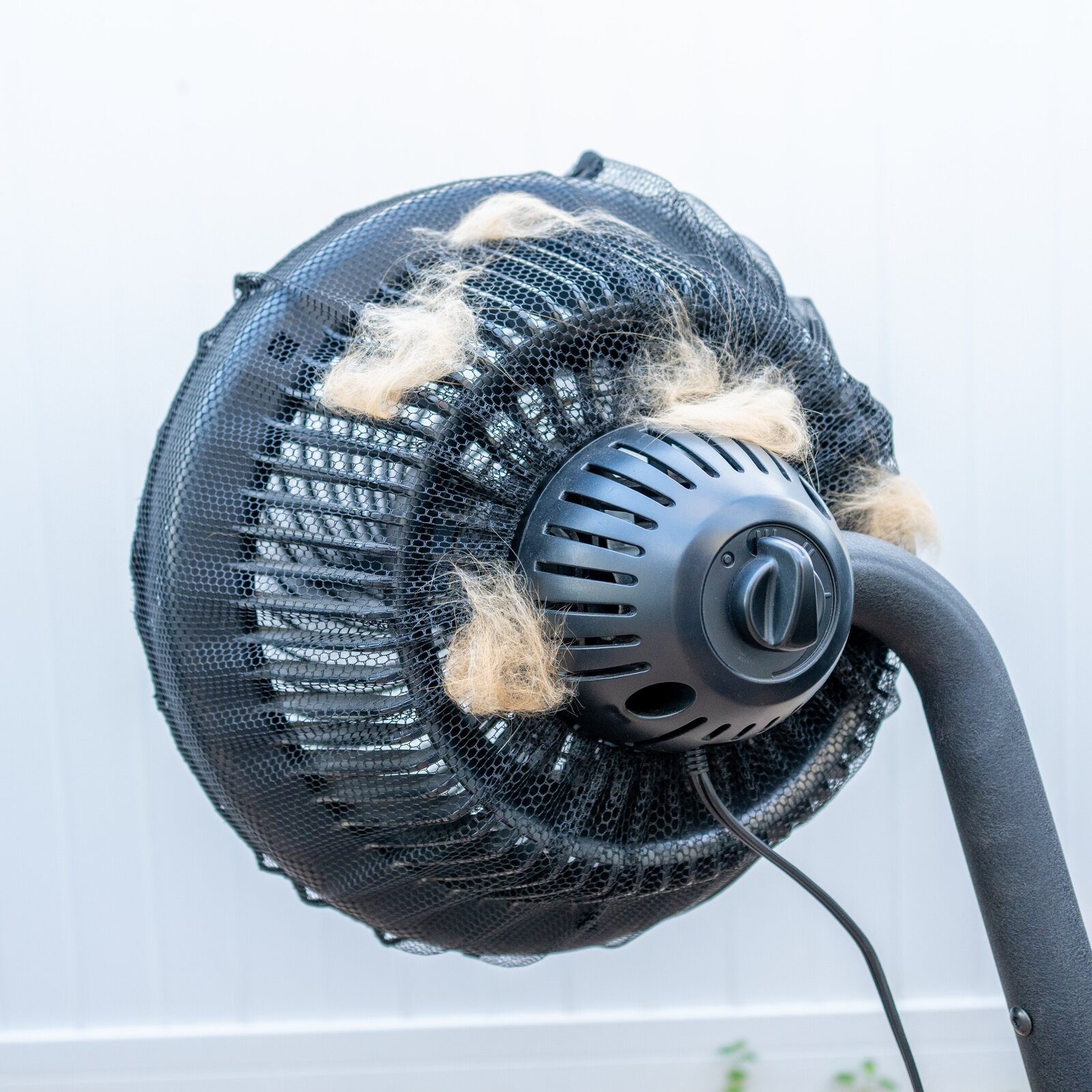
Stop the hair from ever getting to the blades. A washable mesh cover with the right hole size sits over the front of the fan, the air goes through, the hair gets caught on the mesh on the outside. The same fan stops being a hair-distributor and starts being a hair-catcher.
The cover I made for this is the FurStopper Fan Filter. Polyester mesh, 1 cm holes (the air moves freely, the hair gets stopped), drawstring closure that cinches it onto any round household fan up to 18 inches. The whole install is about 10 seconds: slip the mesh over the front of the fan, pull the drawstring tight at the back, you're done. No tools.
What you'll see: instead of hair appearing on every surface in the room, the hair appears on the outside of the mesh. In a multi cat house the mesh fills up visibly between washes. That's hair that would have been on your couch, your clothes, the floor in the next room. When the mesh fills up, vacuum it (with the fan still on low, the airflow holds the hair in place) or pull it off and throw it in the wash. Put on a fresh one, the rotation continues.
What doesn't work
The hacks that won't fix this
Pillowcase over the front. Reddit's classic trick. The cotton catches some hair, but cotton has way too tight a weave for fan airflow. The fan turns into a wheezy hair-bag, the airflow drops to almost nothing, the pillowcase falls off if there's any vibration, and the whole setup looks bad. Skip this.
Wiping the blades with a dryer sheet. Reduces static for about a day. The static returns, the hair returns, you're back to the original problem. Doesn't solve anything for more than 24 hours.
Replacing the fan. Some people give up and buy a tower fan or a bladeless Dyson, hoping the new design solves the hair problem. It doesn't. Tower fans cake too. Bladeless Dyson fans pull air through a small motor housing that hates hair even more than blades do.
Running an air purifier instead. Different category, doesn't fix the fan. The purifier handles dander, the fan still spreads hair. The full breakdown is on the air purifier vs fan comparison.
Install
Putting it on, in 10 seconds
- Turn off the fan. Unplug it if you want to be careful, the install is short either way.
- Slip the mesh over the front. The opening is wide enough to clear the grille on most household fans up to 18 inches.
- Pull the drawstring tight. Cinch it behind the grille (front mount) or at the bottom of the base (top mount, for fans with a solid stand). The string holds it snug.
- Tuck or wrap the leftover string. About a foot of slack remains after cinching. Tuck it into the mesh away from the blades, or wrap it once around the fan stem and tape it down. Just keep it away from moving parts.
- Turn the fan back on. The airflow comes through the mesh as expected. Within a couple days you'll see hair start collecting on the outside.
More cat hair gear coming
Working through the rest of the gear in my 3 cat house. Drop your email if you want updates when something new earns a spot.
One-tap unsubscribe in every email. See the privacy policy.
Frequently asked
FAQ
How do I stop my fan from blowing cat hair around the room?
Put a washable mesh cover on the front of the fan. Hair lands on the outside of the mesh instead of getting pulled through the blades and re-entering the room as smaller particles. The fan keeps moving the same air, the mesh catches what the air carries. The FurStopper Fan Filter is the cover I made for this. Slips on in 10 seconds, drawstring closure, fits most household fans up to 18 inches.
Why does my fan blow pet hair everywhere?
Two reasons. The fan is pulling hair-laden room air through itself, and the spinning blades are throwing whatever is on them back out. So the fan is both pulling new hair in and broadcasting the hair already on the blades. With pets in the house, the fan becomes a hair-distribution machine within a week of being clean. The fix is to catch the hair before it ever reaches the blades.
Does putting a pillowcase over a fan work?
Sort of, badly. A pillowcase catches some hair, but the cotton kills the airflow. You bought the fan to move air, the pillowcase makes it almost not move air. It also looks awful, falls off if there's any vibration, and isn't safe near moving parts. A purpose-built mesh cover (1 cm holes, drawstring closure, fits the fan) catches the hair and keeps the airflow going. That's what the FurStopper Fan Filter is.
Can I just use a HEPA filter on a fan?
The DIY box-fan-and-furnace-filter trick is real and works for fine dust and smoke, but it's not the right tool for hair. HEPA-grade filters have very small pores (0.3 microns) and they clog with hair fast. A coarse mesh (1 cm holes) is what you want for hair specifically: the air still moves freely, the hair lands on the mesh, you wash it. For round household fans, that's the FurStopper Fan Filter. The DIY box fan is a different tool for a different particle size.
How do I install a Fan Filter on my fan?
Slip the mesh over the front of the fan, pull the drawstring tight at the back, you're done. Ten seconds. No tools, no clips, no adhesive. The drawstring lets it fit fans of different sizes, anything round and up to 18 inches. The full step-by-step is on the FurStopper Fan Filter review.
This page is part of the Air & Fans hub. The deeper read on why a fan is actually the right tool for catching hair is on the air purifier vs fan comparison.