Why Your Fan Gets Disgusting So Fast (and How to Stop It)
You clean the fan, two weeks later it's filthy again. The reason isn't the cleaning, it's the design. Here's the physics, the chore everyone hates, and the prevention shift that ends the cycle.
Every cat owner has had this conversation with themselves. You finally took the fan apart last Saturday, you scrubbed every blade, you put the grille in the bathtub with dish soap, you reassembled it. Two weeks later you walk past the fan and the blades are caked again. Did you imagine cleaning it?
You didn't. The fan got dirty fast because fans are designed to do exactly what makes them get dirty fast in a pet house. The fix isn't cleaning more often, it's preventing the buildup from happening in the first place.
The physics
Why a fan attracts pet hair like a magnet
Two forces work together to cake your fan in days. First, every spinning plastic blade builds a static charge as it cuts through air, and that static charge grabs at any hair that comes near it. Hair sticks to the leading edge of the blade and doesn't let go. Second, the fan is moving thousands of cubic feet of air per minute past itself, so it's actively pulling room air (and everything in it) into a single column. Hair that was floating two feet away ends up on the blades a few seconds later.
In a no-pet house, the load is mostly dust, the buildup is slow, you maybe think about cleaning the fan a couple times a year. In a multi cat house the load is hair, fast, and visible. Cat hair shedding off Leo, Luna, and Herbie ends up on the fan because the fan is pulling air past itself and the hair gets pulled with it. The blades are sticky-by-static and the fan is suction-by-airflow, and there's a lot of hair in pet-house air.
Cheap plastic blades hold more static than higher-end ones, that's why some fans cake faster than others. But the underlying problem is shared. Every household fan accumulates hair when there are pets in the house, and every household fan eventually gets gross.
The chore
Why you keep putting it off
You're putting it off because cleaning a fan properly is a 30 minute job. The standard procedure, from any cleaning guide on the internet:
- Unplug the fan.
- Find a screwdriver. Locate the screws holding the front grille to the back grille. Unscrew them all (usually 4 to 8 screws).
- Remove the front grille. Hold the blade with one hand, unscrew the blade nut with the other hand.
- Pull the blade off the motor shaft.
- Wipe each blade, individually. Both sides. Get into the curved part where dust hides.
- Take the front and back grilles to the bathtub or sink. Run them under hot soapy water. Use an old toothbrush for the wire mesh.
- Dry everything. The grilles have to be fully dry before reassembly or rust starts.
- Reassemble. Blade onto motor shaft, blade nut tightened (correct direction or it loosens while spinning), grille back on, screws back in.
- Plug it back in, turn it on, hope you didn't strip a screw or lose the blade nut.
That's a 30 minute job for one fan, and most pet owners have multiple fans. Doing this every two weeks is unrealistic, so it doesn't happen, so the fans stay dirty for months, so when you finally clean them it's worse. The cycle is real and frustrating.
The shift
Catch the hair on the outside instead of the inside
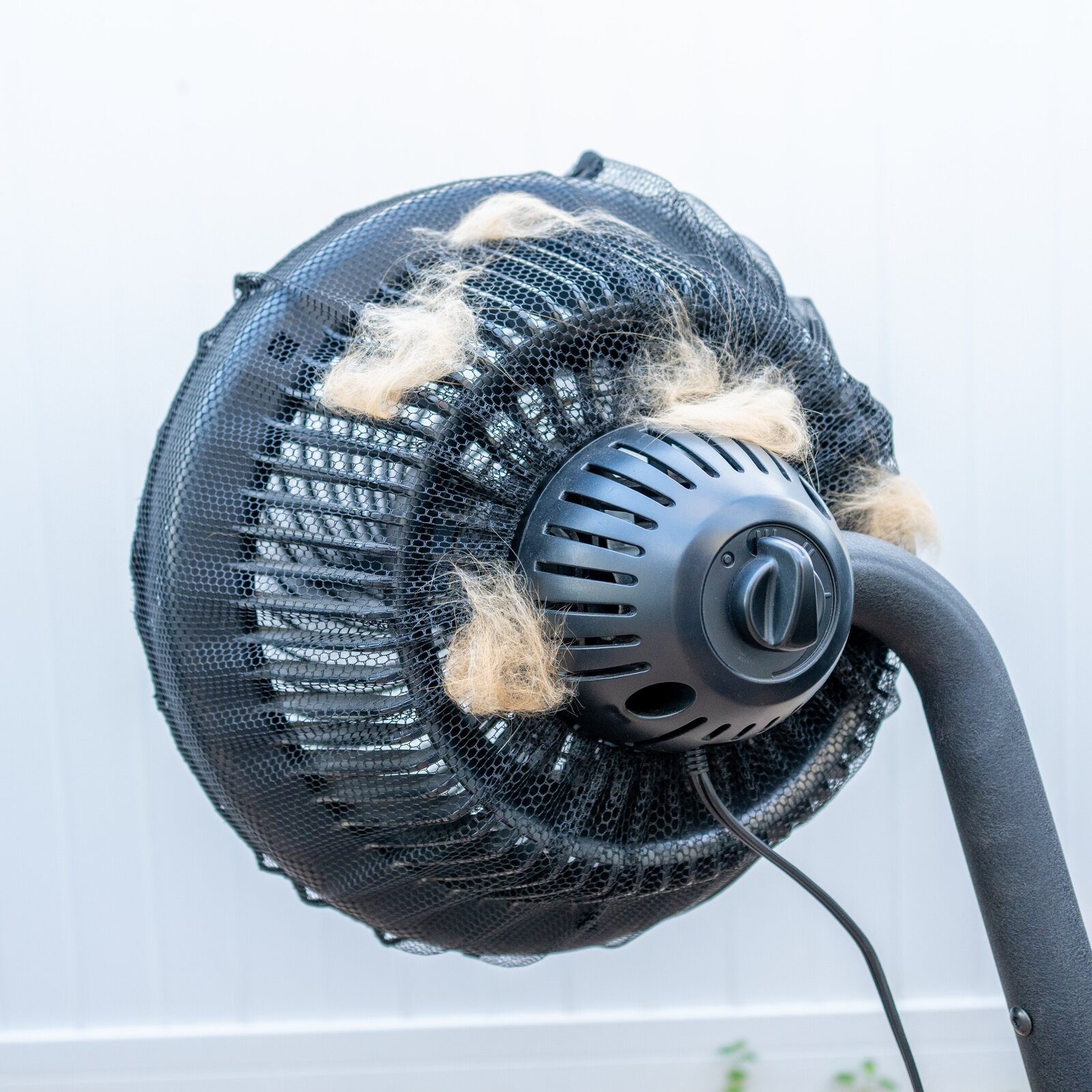
The fix is to stop the hair from ever reaching the blades in the first place. If a washable mesh cover sits over the front of the fan, the hair lands on the mesh on the outside, which is sitting in the airflow but not touching anything moving. The fan still moves the same air, the blades stay clean, and the mesh is something you can pull off, vacuum, and toss in the wash without picking up a screwdriver.
That's exactly what the FurStopper Fan Filter is. A mesh cover with a drawstring closure that fits most household fans up to 18 inches. It catches hair on the outside of the fan, the air still moves through the mesh, the blades stay visibly clean for months instead of days. When the mesh loads up, run a vacuum across it while the fan is on low (the airflow holds the hair in place), then pull the mesh off and put it in the laundry. The whole process is 60 seconds and you never disassemble the fan.
The shift is from cleanup to prevention. Cleanup is the disassembly chore everyone puts off. Prevention is a mesh that catches hair before it ever becomes a problem. One you do every weekend and lose. The other you set up once and stop fighting.
The new routine
What weekly fan maintenance looks like with a Fan Filter
- Look at the mesh. If it's visibly coated, do step 2. If not, you're done, walk away.
- Vacuum the mesh on the fan. Turn the fan to low so the airflow keeps the hair pinned. Run a hose attachment along the mesh, top to bottom. Most of the load comes off in 30 seconds.
- Swap if needed. If the mesh is fully loaded or starting to wear in spots, pull it off, throw it in the wash with the rest of the laundry, put a fresh one on. The 3 pack and 5 pack exist for this rotation.
That's the whole routine. No screwdriver, no soapy bathtub, no half hour of reassembly. Disassemble the actual fan once a season at most, just to wipe the housing dust off the back, but the blades inside should be remarkably clean because the mesh on the front caught everything before it reached them.
A multipack covers a typical pet house with rotation built in. One on the fan, one drying, one in the closet, one on a second fan, one ready to swap. Compared to spending Saturday on the fan, the math is good.
More cat hair gear coming
Working through the rest of the gear in my 3 cat house. Drop your email if you want updates when something new earns a spot.
One-tap unsubscribe in every email. See the privacy policy.
Frequently asked
FAQ
Why does my fan get covered in pet hair so fast?
Two things. Spinning plastic blades build up a static charge that grabs hair as it passes. And the fan is pulling hundreds to thousands of cubic feet of air per minute through itself, so any hair drifting in the room gets a chance to ride that airflow into the blades. With pets in the house, the airborne hair load is higher than the fan was designed to handle, so it cakes in days instead of months.
How often should you clean a fan with cats or dogs?
Most cleaning guides say every 2 to 4 weeks. With pets it's every week to keep up. The full disassembly takes 30 minutes, nobody enjoys it, most people skip it for months and the fan ends up filthy. A mesh cover on the outside ends the cycle.
Is there a way to keep a fan clean longer?
Yes. Put a washable mesh cover on the front of the fan so the hair lands on the outside before it ever reaches the blades. The FurStopper Fan Filter is the cover I made for this exact problem. Hair collects on the mesh, you vacuum it or wash it when it loads up, the blades stay clean for months instead of days.
Can dryer sheets keep a fan from getting dusty?
Sort of, briefly. Wiping the blades with a dryer sheet reduces static for about a day, then the static comes back and so does the dust. It's a temporary trick that doesn't fix the underlying problem of having a high CFM machine pulling hairy room air through itself. A mesh cover on the outside actually catches the hair before it gets to the blades, which is the only fix that lasts.
Why does my fan blow dust around the room?
Because there's already a layer of dust and hair on the blades, and the fan is throwing pieces of it back into the room as it spins. Once a fan is dirty, every minute it runs is redistributing the buildup. The fix is to get the blades clean once and then prevent the buildup from re-forming.
This page is part of the Air & Fans hub. The full air purifier vs fan comparison covers the math on why a fan with a mesh outperforms a purifier for visible hair.