Petkit FreshElement Solo Review: A Year With 3 Cats and 3 Feeders
The best automatic cat feeder for multiple cats isn't a multi-bowl feeder. It's multiple single-bowl Solos, one per cat, in different rooms.

I have 3 cats and 3 Petkit FreshElement Solos, one per cat, in 3 different rooms. They've been running for over a year on plug power and have never missed a meal. $80 a unit, no fights at the bowl, no shy cat skipping breakfast. This is the smart cat feeder strategy I'd give anyone with more than 1 cat.
This is part of the cat home gear roundup, broken out into a full review because the multi-cat feeder question gets answered wrong everywhere I look. Everybody recommends the big multi-bowl unit. I bought 3 cheap singles instead and it solved every problem the multi-bowl was supposed to solve.
The strategy
Why I run multiple Solos instead of one multi-bowl
Every multi-cat feeder review tells you to buy the 2 bowl Petkit or the 4 bowl PetLibro. I tried that math and it doesn't work. A 2 bowl feeder forces both cats to eat at the same address. In my house that's a non-starter, Luna won't approach a dispenser, and the dominant cat would just camp at the station and eat both meals.
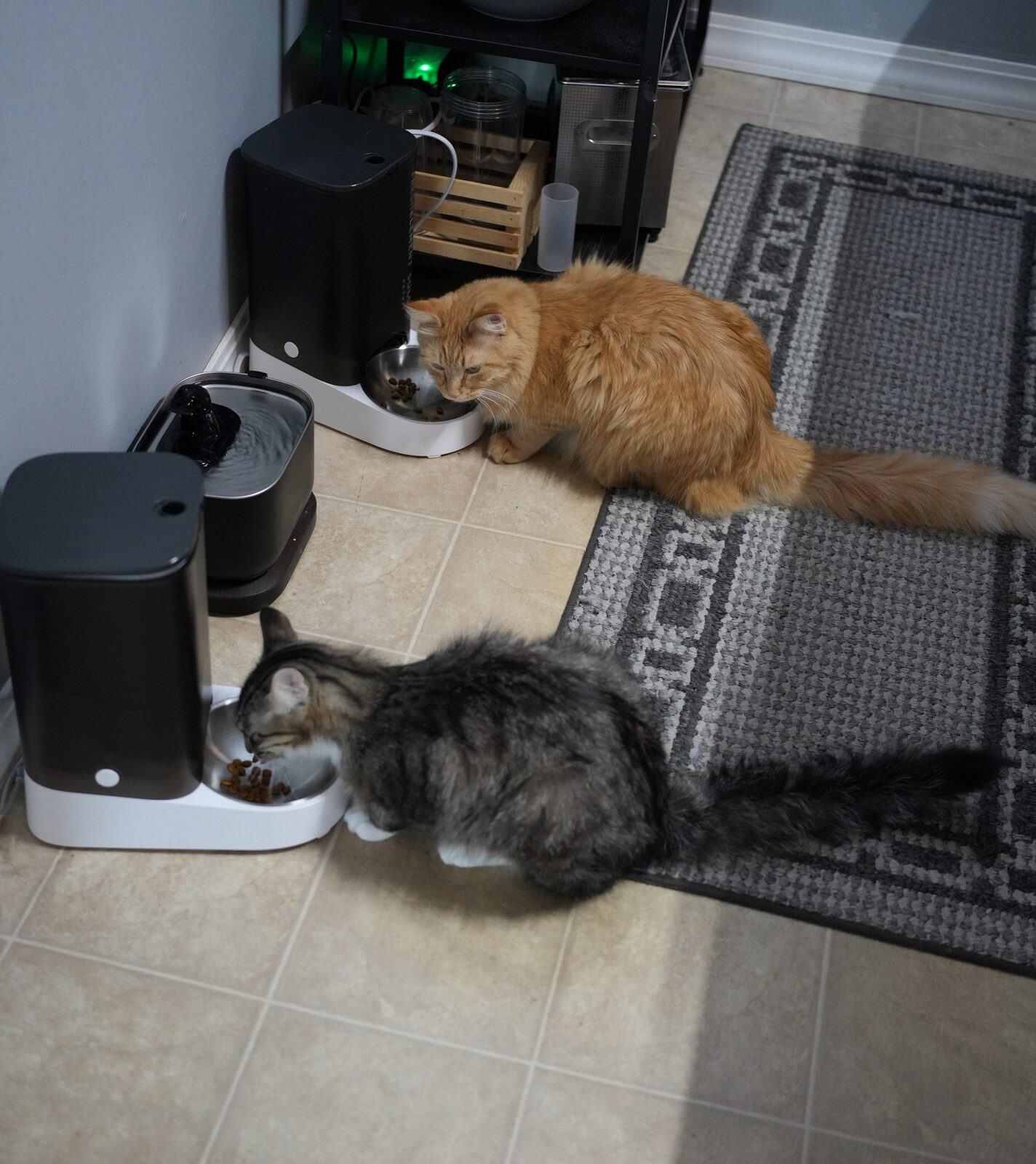
So I bought a Solo for $80 and put it in the kitchen. Then I bought a second Solo and put it in the bedroom. Then a third for the office. 3 cats, 3 stations, 3 schedules. Each cat eats where they're comfortable, each gets the right portion, and there is zero negotiation at meal time.
The price math actually favors multiple singles. A 2 bowl Petkit runs around $120, the 4 bowl PetLibro is $150. 2 Solos at $80 each is $160, which is $40 more than the multi-bowl, and you get the flexibility plus you can pull the bowls off for a shy cat. For 3 cats I spent $240 on 3 Solos. A 4 bowl unit at $150 saves you $90 and gives you 1 fight every meal. I'd rather spend the $90.
The other thing nobody mentions is that if you adopt a 4th cat, you buy a 4th Solo. With a multi-bowl you're stuck with the bowl count you picked at checkout.
The unit
What the Solo actually does
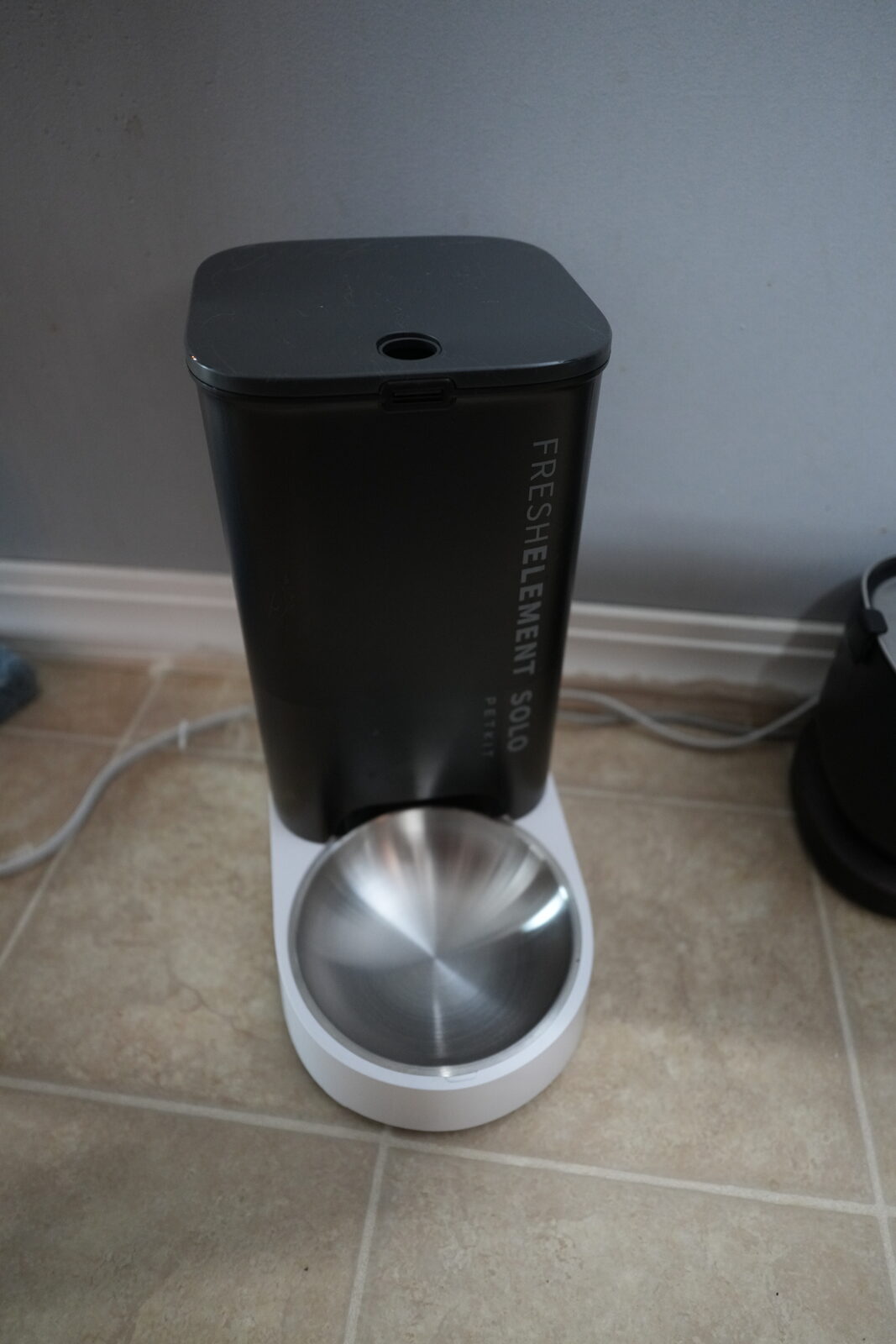
The hopper holds 3L of dry kibble, roughly 12 cups or 2.9 pounds. With 1 cat per unit that's about 2 weeks of food before I refill. The app schedules up to 10 meals per day per unit, each with its own portion size measured in 10g increments. I run mine at 3 meals a day, breakfast around 6am, lunch at noon, dinner at 5pm. The cats know.
The bowl is the part that matters. Stainless steel, removable, dishwasher safe. You unclip the bowl from the front of the unit and it comes off in your hand. That's the difference between this and every cheap feeder where the bowl is plastic and molded into the chassis.
The triple Fresh-Lock seal on the hopper actually works. I refill kibble every 2 weeks and the food at the bottom tastes the same as the food I poured in, no stale smell. Mine sits in a kitchen that gets warm in the summer and the seals have held up.
It's a plug-in unit. The 5 AAA battery slot is for outage backup. I've never put batteries in any of my 3 Solos and they've all run for a year on plug power without missing a meal. Treat the AAAs as optional unless you have unreliable power.
Real-use
Living with it across 3 cats
Before the Solos I was scooping dry food into 3 bowls twice a day, every day, with 3 cats yelling at me. Leo would finish his bowl in 2 minutes and start in on Herbie's. Luna would wait for the chaos to die down and sometimes miss eating entirely. The 6am cat-on-the-bed wake-up was a daily thing.
A year in, the cats line up at their stations 30 seconds before each scheduled dispense. They hear the motor spin and they're already there. Leo eats in the kitchen. Herbie eats in the kitchen too, on a Solo placed at the other end of the counter so they don't even share a sightline. Luna eats from her bowl in the bedroom, sometimes pulled off the unit and set in front of her if she's hiding under the bed that day.
The shy cat thing is the killer feature nobody talks about. Luna is the smallest of my 3 cats and the most skittish. She is one of 2 outdoor rescues in the house, she didn't grow up trusting appliances. A motorized feeder dispensing kibble at 6am is not her favorite thing. With the Solo I just pop the stainless bowl off, carry it to wherever she's hiding, and put it down. She eats. A multi-bowl feeder doesn't let me do this, the bowls live where the unit lives.
Reliability has been a non-issue. Across 3 units running 3 meals a day for over a year, that's roughly 3,000 dispenses each, 9,000 total. Zero jams on standard kibble. Zero missed meals. The only issue I've ever had was when I tried mixing freeze-dried chunks into the kibble and one piece bridged in the hopper, which is on me, not on Petkit.
More cat home gear reviews coming
I'm working through every appliance in my house for the cats. Litter robots, water fountains, the air purifier I run in the kitchen. Drop your email if you want updates when something new earns a spot.
One-tap unsubscribe in every email. See the privacy policy.
The app
What the app actually adds
The app is the part of a smart feeder review I usually skim, so I'll keep it short. The Petkit app is fine. It runs each Solo as its own device, you name them ("Kitchen", "Bedroom", "Office") and set schedules per unit. That per-unit independence is the whole point of running multiples.
The 2 things I actually use: low-food alerts and manual feed. The hopper alert pings me when a unit is getting empty so I can refill before it actually runs dry. The manual feed button is for when I'm staying out late and want to push dinner an hour. I tap once, the unit dispenses, I get on with my night.
The Solo is 2.4GHz WiFi only, which is the one annoying setup quirk. If your router is dual-band you'll need to enable a 2.4GHz network for setup. After that the schedule lives on the unit itself, so even if WiFi drops the dispense still fires on time. You only lose the app features.
I don't use the camera-feeder versions. I don't need to watch my cats eat from the office. The Solo's job is to dispense, that's all I want from it.
Pros
- Removable dishwasher-safe stainless bowl, the single most-used feature
- 3L hopper holds about 2 weeks of food per cat
- Triple Fresh-Lock seals keep kibble fresh from the top of the hopper to the bottom
- Schedule lives on the unit, dispenses fire even when WiFi is down
- App handles low-food alerts and manual feed, that's all I need
- Reliable across thousands of dispenses, zero jams on standard kibble in a year
- $40 to $80 a unit makes the multi-Solo strategy affordable for 2 or 3 cat homes
Cons
- 2.4GHz WiFi only, dual-band routers need a 2.4GHz network enabled
- Dry food only, no wet food capability
- Larger kibble or freeze-dried mixers can occasionally bridge in the hopper
- The original Solo is being phased out for newer Petkit models, specs vary slightly
Frequently asked
FAQ
Is the Petkit FreshElement Solo good for multiple cats?
Yes, but the trick is to run one Solo per cat instead of buying a multi-bowl feeder. With 3 cats I run 3 Solos in different rooms, each on its own schedule, each portioned to that cat. No fights, no resource guarding, no shy cat skipping meals because she won't approach the dispenser.
Petkit FreshElement Solo vs PetLibro, which is better?
I run Petkit. The Solo's stainless steel bowl pulls out and goes in the dishwasher, the app is reliable on 2.4GHz WiFi, and mine have been on plug power for a year without missing a meal. PetLibro is the cheaper option. If you want a removable dishwasher-safe bowl and a feeder that just works, Petkit is the one I'd buy again.
Does the Petkit Solo work without WiFi?
Yes. The schedule lives on the unit itself, so once it's set up the feeder dispenses on time even if your WiFi drops. You only need WiFi to change the schedule, get low-food alerts, or trigger a manual feed from the app. The Solo is 2.4GHz only, so dual-band routers need a 2.4GHz network enabled for setup.
How much food does the Petkit Solo hold?
The hopper holds 3L of dry food, roughly 12 cups or about 2.9 pounds. With 1 cat that's a couple of weeks of food. With 3 cats split across 3 Solos, each unit feeds one cat for around 2 weeks before I refill it. The app pings me when a unit is running low.
Can the Petkit Solo handle wet food?
No. The Solo is a dry-kibble feeder, the hopper and dispense mechanism are not built for wet food. If you feed wet, you want a separate chilled wet-food feeder, the Solo is the wrong tool. I run dry kibble through mine and serve wet food by hand.
Why is my Petkit Solo not dispensing?
Almost always one of three things. The kibble is too big and bridging in the hopper, the dispense outlet has a stuck piece you can clear with a finger, or the unit lost power and the schedule didn't fire. Mine has dispensed thousands of meals across a year and never jammed on standard kibble. Larger pieces or freeze-dried mixers are the usual cause.
How do you clean the Petkit FreshElement Solo?
The bowl pulls off and goes in the dishwasher, that's the whole pitch. I wipe down the dispense chute with a dry cloth every couple of weeks and empty the hopper to vacuum out kibble dust every couple of months. The hopper itself is not dishwasher safe, the bowl is.
Does the Petkit Solo have a battery backup?
It has a slot for 5 AAA batteries as backup for power outages. I've never put batteries in mine. They've been on plug power for a year and have never missed a meal. If you live somewhere with frequent outages, drop the AAAs in. Otherwise treat them as optional.
Is the Petkit Solo worth it vs a manual scoop?
For 1 cat with a flexible schedule, a scoop is fine. For 3 cats on different feeding routines, the Solos pay for themselves in stress alone. No more 6am cat at the bedroom door, no more guilty scoop when you're out for dinner, no more guessing whether someone got fed twice. The cats line up at the dispense time, every day.
The Solo handles the food side of the cat appliance stack. The other 2 boxes I'd automate are the litter box and the litter refill. The Litter Robot 4 review covers the self-cleaning side, and the Litter Hopper review covers the auto-refill add-on. Together with the Solos, that's 3 daily cat chores I no longer do by hand. The cat hair bedding guide covers what I changed once the appliance side was sorted.
How I tested
The bar these things had to clear
Bought multiple at retail
Paid retail for 3 Solos, one per cat. No review units, no Petkit freebies. $80 a unit at the time, the going rate is $40 to $80 depending on sales.
Running daily for over a year
3 units, 3 meals a day, 3 cats. That's roughly 9,000 dispenses across the fleet. Plug power only, no AAAs, zero missed meals.
Replaced manual feeding
Before: scooping kibble into 3 bowls twice a day with 3 cats yelling. After: cats line up at scheduled times, everyone gets the right portion, I get my mornings back.